Monday, August 18, 2014

U.S. Economy Hindered By Decades of Flat Wages


As most people know, the engine that drives the US economy is consumption. In fact, consumers account for 70 percent of the nation's GDP.

So, in order for the economy to function properly, consumers must have adequate incomes to fund all that consumption. Therein lies the problem.

The US economy has continued to struggle since the Great Depression due to an affliction of stagnant wages. In fact, as I've illustrated previously, the US economy has been slowing for decades, largely for this reason.

Adjusted for inflation, wages have been stagnant since the 1970s, reports the Milken Institute. That is a stunning revelation. This stagnation, in conjunction with the widespread prevalence of low-wage jobs, is hindering the economy.

The number of employees working in low-wage jobs has been rising since 1979, according to John Schmitt, senior economist at the Center for Economic and Policy Research.

Though these disturbing trends have been decades in the making, the consequences are now being felt more than ever.

According to the Economic Policy Institute, “the vast majority of U.S. workers—including white-collar and blue-collar workers and those with and without a college degree—have endured more than a decade of wage stagnation.”

Predating the Great Recession (between 2000 and 2007), the median worker experienced slow wage growth of only about 2.6 percent per year, and from 2007- 2012 (during the recession and post-recession hangover) wages fell, which, in essence, means that wages have remained flat.

This has depressed demand and consumption, holding back the economy in the process.

It's no surprise that if Americans don't have adequate incomes they can't spend the economy into robust growth.

Out of 34 industrialized countries, the U.S. had the highest share of employees doing low-wage work in 2009, according to OECD data.

In fact, one-in-four U.S. employees were low-wage workers in 2009, according to the OECD. That is 20 percent higher than in the number-two country, the United Kingdom. Low-wage work is defined as earning less than two-thirds of the country's median hourly wage.

To compensate for this, the US economy continues to be fueled by asset bubbles and escalating household debt.

However, as we all witnessed in the fall of 2008 when our nation's debt bubble finally burst, these responses result in some rather devastating outcomes. We're still living with the aftermath of the Great Recession.

Yet, while the typical American worker has fallen further and further behind through the years, the nation's top earners have thrived. The income of the top 1 percent nearly quadrupled from 1979 to 2007.

But no matter how rich they are, the top 1 percent cannot possibly buy enough stuff, or use enough services, to make up for the wage stagnation of the masses.

There has been a steady, long-term decline in the US economy over many decades.

The annual GDP growth rate in the United States averaged 3.25 percent from 1948 through 2014. However, since 2001, GDP has only reached at least 3 percent in two years: 2004 (3.8 percent) and 2005 (3.4 percent). In every other year, GDP failed to crack 3 percent.

In the 1950s and '60s, the average growth rate was above 4 percent. In the 1970s and '80s it dropped to around 3 percent. But in the last ten years, the average rate has been below 2 percent.

Our economic decline dovetails with the decline in wages through the years. There is no denying that four decades of stagnant wages have led to our continuing economic stagnation.

This is why we've become so reliant on household debt and the asset bubbles forged by the Federal Reserve to continue eking out marginal economic growth.

What's particularly perverse about this wage stagnation is that American workers have managed to be ever more productive. Though productivity grew 7.7 percent from 2007-2012, wages fell for the entire bottom 70 percent of the wage distribution.

The longer term trends are even more troubling.

The median worker saw a wage increase of just 5 percent between 1979 and 2012, despite productivity growth of 74.5 percent.

The last decade, however, was particularly bleak for American workers.

Between 2002 and 2012, wages were stagnant or declined for the entire bottom 70 percent of the wage distribution. In other words, notes the Economic Policy Institute, the vast majority of wage earners have already experienced a lost decade.

In reality, it's been more like lost decades.

This is the sad truth in the United States, the nation that most Americans like to believe is one of opportunity, promise and hope. However, the reality simply doesn't square with those lofty beliefs.

This nation cannot remain great when such vast numbers of its citizens are continually falling further behind — even the skilled and the educated.

The fact that so many workers are facing great financial struggles is particularly troubling when corporate profits are at historic highs.

The Economic Policy Institute describes the problem thusly:

"The weak wage growth since 1979 for all but those with the highest wages is the result of intentional policy decisions—including globalization, deregulation, weaker unions, and lower labor standards such as a weaker minimum wage—that have undercut job quality for low- and middle-wage workers."

Globalization notwithstanding, these are political problems manifested as economic problems. That is to say, monied, corporate interests have influenced lawmakers and gotten them to do their bidding.

It also means that these trends are reversible. However, that requires political will, integrity, and a determination to serve the citizenry, the masses, and the electorate.

Unfortunately, those qualities are in short supply in our nation's capital.

Sunday, July 20, 2014

BRICS Challenge Western-Run International Finance System


The leaders of the BRICS nations – the emerging markets of Brazil, Russia, India, China and South Africa – announced in Brazil the launch of a $50 billion development bank this week. The move by the five nations is in response to the Western influence of the US-dominated World Bank.

Though it will be much smaller and less funded, the new bank is an attempt to counterbalance the hegemony of US and Western banking interests. In essence, it is an attempt to expand the financial relevance of the world's emerging economies.

The BRICS also set up a $100 billion currency reserves pool to help countries manage their short-term liquidity troubles during a currency crisis. The decision presents a small, but potentially growing, challenge to the International Monetary Fund (IMF), which is based in Washington, DC.

The World Bank finances development projects around the world, and the IMF is the lender of last resort to countries that don't have the dollars to pay their foreign debt.

Unable to exert more influence over the World Bank and IMF, the BRICS will now gain greater control over the funding decisions that directly affect them.

Though China is one of the world's two largest economies, it has less voting power in the IMF and World Bank than Belgium, the Netherlands and Luxembourg. Yet, China has 1.3 billion people, while those three European nations have less than 30 million people combined.

Belgium — a county with 11 million people and a $508 billion economy — has more IMF votes than Brazil — a nation of 199 million people and a $2.2 trillion economy.

Frustrated that their economic weight is not reflected in global financial institutions, the BRICS countries have now established one of their own.

In the process, they have suddenly carved out a larger role for themselves in international finance.

At the least, they have created some global competition for international lending.

Initially, the bank will have $50 billion in capital, divided equally among its five founders. The bank will start with just $10 billion in cash put in over seven years and $40 billion in guarantees, and it won't start lending until 2016. However, capital is planned to eventually grow to $100 billion.

To put this in perspective, subscribed capital in the World Bank is $223 billion.

The development bank, which will be based in Shanghai, intends to fund development and infrastructure projects in developing nations. India will lead operations for the first five years, followed by Brazil and then Russia.

The BRICS nations banded together in 2009 to press for a large role in the global financial system created by Western powers in the post-World War II Bretton Woods agreement.

Given that they account for almost half the world's population and about a fifth of global economic output, the BRICS' influence will likely continue to grow.

In fact, other nations, such as Indonesia, Mexico and Turkey, could ultimately join the development bank.

The bank is the biggest undertaking and the most significant achievement of the BRICS in their five-year partnership.

When the BRICS first announced their intention to form the bank in April of 2013, it was greeted with great skepticism in the West. But the emerging nations have shown their willingness to coordinate, cooperate and act.

Wary, and weary, of the terms and conditions applied by IMF and World Bank, the BRICS can now turn to one another for the financing of their development and infrastructure needs.

The US and, more broadly, the West may not have taken seriously this challenge to their supremacy in the world economy a year ago. But it's a good bet they're paying attention now.

Moreover, the creation of the development bank is not the end of the BRICS' ambitious plans.

These nations have previously called for an end to the dollar's singular role in international trade and the settlement of debts.

For example, since crude oil is bought and sold in dollars, the BRICS have publicly voiced their interest in collaborating in non-dollar oil payments. Their hope is to have an alternative payment system in place by 2018.

In 2012, the BRICS announced plans to extend credit to each other in their own currencies, with the goal of eventually replacing the dollar with their own currencies for trade amongst themselves.

That's a direct challenge to the dollar's role as the world's reserve currency.

So, the development bank may be just the beginning. It may take a few more years, but the BRICS are determined to increase their role and influence in international finance and credit, while simultaneously diminishing that of the US and the West.

Wednesday, July 09, 2014

Officials Unprepared for Southwest's Unfolding Water Crisis


The American Southwest is a vast, arid desert. Yet, it is home to some 40 million people and the cities of Las Vegas, Phoenix and Los Angeles. All of them are served by the dwindling water resources of the Colorado River and one of its primary reservoirs, Lake Mead.

A massive civil engineering project in the 1960s diverted part of the Colorado River to feed Phoenix and Tucson. Those cities could not exist in their current state without this unnatural influx of Rocky Mountain snowmelt.

A quarter of Arizona's water comes from the Colorado River, which has been drained to dangerously low levels. There's not enough water in the basin to keep Arizona's crucial Lake Mead reservoirs topped up. As of this week, the lake is about 39 percent full.

Lake Mead's surface is now about 1,080 feet above sea level, which is below the 1,082-foot level recorded in November 2010 and the 1,083-foot mark measured in April 1956 during another sustained drought.

If current trends continue, the level will drop to 1,000 feet by 2020, says the federal government. That's just six years from now.

Under present conditions, that would cut off most of Las Vegas’s water supply and much of Arizona’s. Phoenix gets about half its water from Lake Mead, and Tucson nearly all of its.

The problem is worsening quickly.

The federal Bureau of Reclamation forecasts that Lake Mead will fall this week to a level not seen since the lake was first filled in 1938. Again, Lake Mead is now about 39 percent of capacity and is dropping steadily.

Last month, officials at the Central Arizona Project (the state’s canal network) said they may have to cut water deliveries to Phoenix and Tucson, its two largest cities, due to the dire state of the dwindling Colorado River.

Despite Arizona's dwindling water resources, the state's population continues to swell. Here's a look at Arizona's population in recent decades:

1970: 1,745,944
1980: 2,718,215 (55.7% increase)
1990: 3,665,228 (34.8% increase)
2000: 5,130,632 (40% increase)
2010: 6,392,017 (24.6% increase)
2013 (est.): 6,626,624 (3.7% increase)

In essence, Arizona's population has nearly quadrupled since 1970. Yet, the desert state is getting ever drier.

Arizona is in the midst of the worst drought ever seen in the state's 110-year long observational record. The last two years were the driest in a century in the Southwest.

Consequently, the state will have to reduce water consumption rather quickly. Mandatory cuts could begin as early as 2019, according to an analysis by the state's water project.

Arizona does not presently have a plan to deal with water shortages as extreme as those being predicted by 2020, just six years from now. It's unconscionable that state officials have allowed the situation to come this far with no actual, valid plan.

The fact that a pending water shortage in Arizona's two biggest cities is just now being raised publicly is tough to comprehend. Denial, or withholding vital information from the public, are not solutions.

Arizona's groundwater levels have dropped by hundreds of feet over the last century. Yet, the state still grows cotton on its arid lands.

According to the Arizona Department of Water Resources, more than two-thirds of Arizona’s water is still used to irrigate fields, down from a peak of 90 percent last century.

However, roughly 42 percent of the land in Arizona is covered by desert. In fact, there are four different deserts in the state, making it a very difficult place to grow food, much less sufficiently feed its 6.6 million residents.

Of Arizona's total area, just 0.32% consists of water, which makes Arizona the state with the second lowest percentage of water area (New Mexico is the lowest at 0.19%).

Climate change will only make the drought situation worse, and the effects are continually occurring faster than scientists had predicted a few short years ago.

Most scientists believe global warming will make an already arid desert Southwest even drier in this century.

Research done at the University of California, Berkeley shows that the 20th Century was an abnormally wet era in the West and that a new mega-drought may be starting.

The U.S. Global Change Research Program projects 20 percent to 50 percent less water by the end of this century, with temperatures 5 to 10 degrees warmer (Fahrenheit).

With 6.6 million residents in Arizona, 4.3 million of whom live in the metropolitan Phoenix area, there are simply too many people vying for far too little water.

Given its limited water resources, the desert region was not meant to support a population that large. Yet, those limited water resources are rapidly dwindling.

However, Phoenix is not alone in facing this issue. Most of the Southwest is reliant on the same water source.

Seven southwestern U.S. states share the Colorado River's water supply under a 1928 allocation agreement that also provides shares of the river water to Native American tribes and Mexico.

“The Colorado is essentially a dying river. Ultimately, Las Vegas and our civilization in the American Southwest is going to disappear, like the Indians did before us,” said Rob Mrowka, a Las Vegas-based scientist at the Centre for Biological Diversity.

Las Vegas, which has more than 2 million residents and about 40 million tourists a year, is almost completely dependent on Lake Mead for drinking water. The city is presently grappling with a water crisis.

“The situation is as bad as you can imagine,” said Tim Barnett, a climate scientist at the Scripps Institution of Oceanography. “It’s just going to be screwed. And relatively quickly. Unless it can find a way to get more water from somewhere, Las Vegas is out of business. Yet they’re still building, which is stupid.”

Monday, June 30, 2014

US Economy Remains Weak and Fragile, Despite Massive Fed Interventions


The Great Recession was the worst economic downturn in the U.S. since the Great Depression. In fact, seven years after it's onset, the nation is still trying to crawl out from under the weight of the recession's burden.

Case in point: The U.S. economy contracted 2.9% in the first quarter, the worst performance since the first quarter of 2009.

Moreover, it was the first quarterly economic contraction in three years, and only the second since the Great Recession ended in mid-2009. The last negative quarter was in early 2011, when growth fell by 1.3%.

So, this contraction was a doozy.

In an effort to help the U.S. along the path to economic recovery, the Federal Reserve is nearly six years into an absolutely massive and unprecedented intervention.

The Fed's quantitative easing (QE) program, initiated in December 2008, has bloated its balance sheet to almost $4.4 trillion. Yet, it is still adding to that absolutely massive sum by buying $45 billion in assets each month.

But that isn't the only extraordinary Fed intervention.

In response to the financial crisis, the subsequent recession, and the collapse in lending/borrowing, the central bank also cut short-term interest rates to historically low levels.

Beginning in December 2008, the Federal Reserve set a target of 0.00 - 0.25% for the Federal Funds Rate, essentially an overnight lending rate for banks. The FFR is presently 0.10%, which allows banks to virtually borrow for free.

It has also allowed large corporations to borrow very, very cheaply.

Despite these unprecedented central bank interventions, the U.S. economy contracted nearly 3 percent in the first quarter, which was like a kick in the gut.

However, the economy's health has remained weak ever since the recession officially ended.

Since the economic recovery began in mid-2009, annual growth has hovered around 2%, well short of the nation’s historical average of 3.3%. In fact, the U.S. economy has not surpassed 3% annual growth since 2005.

This is rather stunning considering the absolutely massive Fed stimulus designed to re-inflate the economy. The central bank's drastic measures have barely made a difference.

Any hope that we'll reach 3% GDP growth this year has been eliminated.

The International Monetary Fund said the U.S. economy would only grow 2% this year, down from its earlier forecast of 2.8%.

And the World Bank has cut its projection for U.S. growth down to 2.1% from 2.8%.

The U.S. economy is driven by consumer spending, which accounts for more than 70% of GDP. Yet, consumers are in no position to be the engine that brings this economy roaring back to life.

Wages and incomes have been stagnant for many years. In fact, household income is roughly the same today, in inflation-adjusted terms, as it was back in 1990. That's why Americans came to rely so heavily on credit during the bubble years.

Credit card debt per indebted household was $17,630 at the end of the first quarter of 2010. However, it has dropped to $15,191 — though it is again on the rise. That four-year decline is substantial.

Meanwhile, overall consumer debt is now 9.1% below its 2008 peak of $12.68 trillion, according to the Federal Reserve.

So, despite all of the Fed's absolutely massive, historic and unprecedented efforts, the economy continues to limp along — now threatening to fall back into recession again — and consumer debt remains well below the level that tanked the economy in the first place.

And therein lies the problem: Ours is a debt-based economy, and without continually expanding debt at all levels — consumer, corporate and government — there can be no return to what was once thought of as "normal."

In short, there can be no growth without debt. However, in light of what happened to the U.S. economy in 2008, perhaps that is a good thing.

Debt is a double-edged sword.

If managed correctly — and kept at levels that allow investment, growth and practicable repayment — it is a useful tool.

If not, it is a financial burden that can tank an entire economy.

We've already seen how that story plays out.

The takeaway here is that the Federal Reserve has already taken massive, extraordinary, and rather drastic measures to get the economy out of recession and resume vigorous growth.

Yet, their nearly six-year efforts are now failing, and that is a frightening reality.

Tuesday, June 24, 2014

Americans are Increasing Debt Just to Buy Essentials


According to the US Federal Reserve, credit card debt currently stands at $854.2 billion, and the average consumer has $15,191 in debt.

Though those figures have declined since the onset of the Great Recession, American consumers are again driving themselves further into debt through the use of their credit cards.

Case in point: There was a whopping 12.3 percent annual increase in revolving credit card balances in April, according to the Federal Reserve.


CardHub projects a $41.9 billion net increase in credit card debt by the end of this year – 8 percent more than last year and 14 percent more than 2012.

The optimistic spin-meisters would have you believe this is a function of higher consumer confidence. But the evidence shows otherwise.

According to Gallup, weekly economic confidence has been flat-lined between minus 13 and minus 15 since the beginning of the year.

That's likely due to the fact that workers are plagued by stagnant wages.

Over the past year, average weekly earnings have risen 2.1 percent — about the same as the 2 percent increase in consumer prices. That has negated the marginal rise in earnings. We'll get back to that rise in consumer prices in a moment.

The median usual weekly earnings of full-time wage and salary workers, adjusted for inflation, has actually declined since the end of the recession, according to government data.

This has caused revolving credit to now become non-discretionary. In essence, Americans are using their credit cards just to afford the basics. It's the only way that many of them can bridge the gap between their stagnant incomes and rising food and gas prices.

Which brings me back to the 2 percent increase in consumer prices noted above. The problem with that figure is that the government doesn't include food and energy prices when calculating inflation.

Consequently, the official inflation rate is quite misleading.

Overall, food costs are more than 2 percent higher than in 2011. However, the consumer price index (CPI) for U.S. beef and veal is up almost 10 percent so far in 2014. Egg prices are also climbing — up 15 percent in April alone — and are expected to rise by 5 to 6 percent this year. And higher milk prices are feeding through to other products in the dairy case, particularly cheese. Additionally, fruits and veggies have jumped more than 3 percent.

"The ongoing drought in California could potentially have large and lasting effects on fruit, dairy and egg prices, and drought conditions in Texas and Oklahoma could drive beef prices up even further," says the U.S. Department of Agriculture.

The spot price of U.S. Foodstuffs — which is not driven by speculation as futures are — is up a whopping 19 percent this year, according to the Commodity Research Bureau index.


The reality is that food price inflation has been higher than overall price inflation for nearly a decade now.

But that's not all.

Gasoline prices have risen more than 10 percent since the beginning of the year, while natural gas and heating oil prices have spiked as well. Higher oil and gas prices ultimately lead to higher food prices.

Consumers are financing their food and energy purchases with credit cards. Of course, this just raises the costs of these purchases in the long run since they add to revolving card balances.

Because consumer spending comprises more than 70 percent of U.S. economic activity, some people will applaud any increase in spending, even if it is debt-based spending for essentials, like food and gas.

However, that's surely not something to celebrate, and it's certainly not the sign of a healthy economy or consumer base.

Tuesday, June 17, 2014

Housing Market, Already Slowing Economy, Appears Unsustainable


The U.S. housing market was at the heart of the financial crisis that led to the Great Recession. Yet, most of the hopes for our economic recovery have been pinned to a housing recovery.

While there has been some semblance of a recovery (home prices have increased 20 percent nationally over the past two years), it has been uneven, differing greatly from market to market.

The S&P/Case-Shiller 20-City Composite Home Price Index shows that in February prices were back around the same levels as in 2004, though still down from their peak in 2006.

Home prices nationwide, including distressed sales, increased 12.2 percent from February 2013 to February 2014, according to CoreLogic. This change represented 24 months of consecutive year-over-year increases in home prices nationally.

However, the housing recovery has been driven largely by investors, not typical buyers.

Sensing an opportunity, institutional buyers have accounted for a large percentage of home purchases, which has boosted prices. This is not a market driven by normal consumer demand.

All-cash purchases accounted for almost 43 percent of all sales of residential property in the first quarter of 2014, up from almost 38 percent in the previous quarter and 19 percent in the first quarter of 2013, according to data released in May by RealtyTrac.

These investors are eager to make a profit by buying low and renting these properties — or flipping them — which is driving up the number of all-cash deals. Wealthy Americans and downsizing empty nesters also account for some of these all-cash deals.

According to the National Association of Realtors' annual study of consumers, the 2014 Investment and Vacation Home Buyers Survey, investors accounted for 20 percent of market share in 2013, down from 24 percent in 2012.

As a result, the median price of a new home rose to $290,000 in March, the highest level on record, according to the Commerce Department.

This is pricing out many first-time and lower-income buyers. When you look at incomes, it's little wonder.

In April, for example, weekly wages for the average American worker were just 0.2 percent higher compared to a year earlier, adjusted for inflation. And real hourly wages were actually down 0.1 percent in the same one-year span.

In real dollar terms, the median annual income is 7.5 percent lower ($4,309) than its January 2008 high.

This makes the 20 percent increase in home prices over the past two years tough to reconcile. It's even more confounding when you look at the broader inflation rate.

The latest annual inflation rate for the United States is 2.1 percent through the 12 months ended May, as published by the US government on June 17, 2014.

So the rise in home prices is wildly out of line with general rise in prices throughout the economy.

As previously noted, this is hurting first-time buyers, many of whom tend to be younger.

The Millennial generation, in particular, is being squeezed out of the housing market. This group is not only contending with rising home prices, but also tighter lending standards, tight supplies and high student loan debts.

Some graduates end up paying off student loans well into their 30s and even 40s. As a result, many Millennials simply can't come up with hefty 20 percent down payments. Others don't have good enough credit to qualify for loans.

Consequently, just 36 percent of Americans under the age of 35 own a home, according to the Census Bureau. That's down from 42 percent in 2007 and it's the lowest level since 1982, when the agency began tracking homeownership by age.

Yet, it's not just Millennials. Home ownership, in general, is on the decline.

Just 74.4 million American households — less than 65 percent of the country — owned the homes they lived in during the first quarter of this year, according to a recent U.S. Census Bureau report.

That was the lowest level since 1995 and a big drop from 2006, when a peak of 76.5 million households, or 68.9 percent, were owner-occupied.

The price of homes, the lack of sufficient down payments, and stricter lending standards have killed any hope of ownership for millions of Americans. What was long considered the "American dream" is no longer the dream for a huge percentage of people.

According to a May poll by the National Endowment for Financial Education, only 13% of Americans considered home ownership as their “top long term financial goal,” down from 17% in 2011.

Lending standards should indeed remain strict. Lax standards helped to drive the housing bubble in the first place. But the stagnation in wages has thwarted the ability of millions of Americans to save for a down payment, or service a mortgage.

The rise in home prices is a two-sided coin. It's been great for owners that have been underwater, and for those seeking to sell their homes. But it's hurt millions of other would-be buyers.

The question is whether the increases in home prices can be sustained. It doesn't seem likely, since it is so out of line with precedents.

Historically, home prices have appreciated nationally at an average annual rate between 3 and 5 percent, according to Zillow, though different metro areas can appreciate at markedly different rates than the national average.

This historical average is important to consider as we look for signs of another housing bubble.

Again, home prices nationwide, including distressed sales, increased 12.2 percent in February 2014 compared to February 2013, according to CoreLogic.

So, price increases over the past year are anywhere from 244 percent to 406 percent above the historical national average.

Cause for concern? Perhaps. This certainly isn't normal appreciation.

Additionally, as interest rates have slowly risen, institutional investors — people or companies that have purchased at least 10 properties in a calendar year — have been gradually leaving the market.

Investors accounted for 5.6 percent of all U.S. residential sales in the first quarter, down from 6.8 percent in the fourth quarter of 2013 and 7 percent in the first quarter of 2013.

One way or anther, this market looks quite tenuous. Incomes don't match home prices, and mortgage rates will only tend to rise.

As it is, the housing market is already slowing down.

New-home construction fell 6.5 percent in May.

Meanwhile, existing home sales saw a 3.4 percent increase in March. However, that was the first gain in nine months. And in April, existing home sales increased just 0.4 percent.

The housing market was a drag on the economy in each of the last two quarters.

Housing cut economic growth in the first quarter, as it did in the fourth quarter of 2013, resulting in the sector’s first back-to-back subtraction since the first half of 2009.

That trend could continue into the second quarter, and beyond.

Clearly, this is something we should watch closely in the months ahead.

Sunday, June 08, 2014

Economy Finally Recovers All Jobs Lost in Recession; Still Not Enough


The good news from the latest Bureau of Labor Statistics (BLS) report was that the U.S. economy added 217,000 jobs in May.

This means the U.S. labor market has finally surpassed its pre-recession level of employment (last seen in December 2007), making this the longest employment recovery in the postwar era.

Think about how much damage the Great Recession caused to our economy; it's taken 6 1/2 years to get back to our former employment level.

However, even after taking into account the number of people who have retired in that span, millions of additional workers have since entered the labor market, meaning we need millions of additional jobs to create adequate employment for everyone that wants full-time work.

For example, over this period, the U.S. civilian population increased by nearly 14.5 million people, but the labor force grew by just 1.7 million new jobs, according to BLS data.

When the media and government discuss the unemployment rate, they typically refer to what is known as the "U-3" unemployment rate. In May, that number was 6.3 percent.

However, the "U-6" figure provides a broader measure of the unemployment rate. When this number is viewed, things don't look nearly so rosy.

The "U-6" includes two groups of people not calculated in the "U-3" figure:

1. "Marginally attached workers" — people who are not actively looking for work, but who have indicated that they want a job and have looked for work (without success) sometime in the past 12 months. This group also includes "discouraged workers" who have completely given up looking for a job because they feel that they just won't find one.

2. People who are looking for full-time work, but who have settled for part-time work due to economic reasons. In essence, these people want full-time work, but simply can't find it.

These are critical distinctions that make "U-6" a far more accurate representation of true unemployment.

The U-6 unemployment rate was 12.2 percent in May, according to the Bureau of Labor Statistics (BLS). That's nearly twice the 6.3 percent figure most often cited by the government and media.

What this means is that there are 23.5 million Americans who either want a job, or want to work full-time, but can’t due to the weak economy.

That is a massive number.

Though this figure is down nearly 5 million from the peak of 30.4 million four years ago, it’s still up 7.5 million from the pre-recession level of 16 million.

With 23.5 million people either unemployed or only working part-time, employers can hold the line on wages and salaries.

Over the past year, average weekly earnings have risen 2.1% — about the same as the 2% increase in consumer prices. That has negated the marginal rise in earnings.

Median usual weekly earnings of full-time wage and salary workers, adjusted for inflation, have actually declined since the end of the recession, according to government data.

A significant part of the problem is that this jobs recovery has been too reliant on low-wage jobs. In fact, low-wage jobs have accounted for two-fifths of all new jobs added.

The bulk of new jobs have been in food services, temporary help services, retail trade, and long-term health care — industries known for low wages.


For example, employment in temporary jobs accounts for 10% of overall employment gains in the recovery, while employment in accommodation and food services accounts for another 17% of total new employment.

Low wage jobs won't address our economy's fundamental problem, which is a lack of demand. Consumers aren’t consuming enough to spur the economy because they don't have the means to do so.

So, while finally recovering all the jobs lost in the Great Recession is certainly good news, it's clear that we need millions of additional jobs — specifically good-paying, middle-class jobs — before we can really celebrate, or think we've returned to anything resembling "normal."

Saturday, May 31, 2014

Dream of US Shale Oil Revolution Goes Up in Smoke


A rather astonishing thing happened about a week ago. It was undoubtedly one of the biggest stories of the year, and it has implications for the United States for years to come.

Yet, you may have completely missed this stunning news.

The U.S. Energy Information Administration slashed by 96% the estimated amount of recoverable oil buried in California's vast Monterey Shale deposits.

Why is this such big news?

The Monterey Shale formation, a 1,750 square-mile area, contains about two-thirds of the nation's shale oil reserves.

In other words, nearly two-thirds of the US shale oil that was previously believed to be recoverable is not. A 96% reduction is a virtual wipeout.

The Monterey formation was previously believed to contain more than double the amount of oil estimated at the Bakken shale in North Dakota, and five times as much as the Eagle Ford shale in South Texas.

But — POOF! — just like that, the contention that shale oil would generate US energy independence, and lead us to surpass Saudi Arabia in production, went up in smoke.

Only 600 million barrels of oil can be extracted with existing technology from this vast stretch of Central and Southern California, far below the 13.7 billion barrels once thought to be recoverable.

To put that into perspective, at current usage levels, 600 million barrels would meet US oil demand for just 33 days. Yes, you read that correctly.

The energy agency said the earlier estimate of recoverable oil, issued in 2011 by an independent firm under contract with the government, broadly assumed that deposits in the Monterey Shale formation were as easily recoverable as those found in shale formations elsewhere.

Apparently, they are not.

Oil driller Occidental, which owns most of leases in the Monterey Shale, earlier this year put its California business up for sale in part due to lagging oil production.

Fracking — the process of injecting millions of gallons of water laced with sand and chemicals deep underground to crack shale formations — has not been productive in the area, which runs down the center of California roughly from Sacramento to the Los Angeles basin and includes some coastal regions.

This is a stunning reversal, and it's a reminder of that old adage: Don't count your chickens before they hatch.

It was previously believed that an oil boom would bring millions of new jobs to California and boost tax revenue by tens of billions annually.

All of those rosy projections were wiped out the instant this news was announced on May 21.

It's hard to overstate what an enormous blow this is to US energy interests.

For California, in particular, this is a huge setback for the economy and for anticipated tax revenues.

In 2013, a USC analysis, funded in part by the Western States Petroleum Association, predicted that the Monterey Shale formation could, by 2020, boost California's gross domestic product by 14%, add $24.6 billion per year in tax revenue, and generate 2.8 million new jobs.

The fact that none of this is true is a kick in the gut to the Golden State. And it could lead to a national oil shock in the coming years that would be devastating to the US economy and our way of life.

If we're ever going to develop energy independence, it will have to come from other means. The shale oil "revolution" was a myth from the beginning, and one that has quickly gone bust.

Perhaps this news will compel California to instead focus more on developing and advancing renewable energy.

That would provide a happy ending to this truly remarkable story.

Thursday, May 15, 2014

Global Population & Global Resources Rapidly Moving in Opposing Directions


The growth of the global population over the last century is nothing short of extraordinary. But humanity's exponential growth is going to pose some great challenges and difficulties for us in the decades ahead.

The world population was an estimated 1.564 billion 1900. However, as of July 2013, the world population had reached an estimated 7.152 billion, according to the United States Census Bureau.

Quite remarkably, the global population quadrupled in the 20th Century.

Population growth in the West became more rapid after the introduction of compulsory vaccinations, and improvements in medicine and sanitation.

However, global population growth was largely driven by greatly increased by food production (which, in turn, was driven by fossil fuels in the form of natural gas-derived fertilizers, oil-derived pesticides, and hydrocarbon-fueled irrigation) that allowed this massive expansion.

As the following chart shows, the global population was relatively stable for many centuries, but then skyrocketed upon the discovery of crude oil.


Absent adequate crude oil and oil-based fertilizers, this population boom cannot continue. Furthermore, billions of additional humans will use vastly greater quantities of resources, many of which are non-renewable and therefore unsustainable.

The UN projects steadily declining population growth in the near future. However, the global population is still expected to reach somewhere between 8.3 and 10.9 billion by 2050.

Yet, some analysts question the sustainability of further world population growth, highlighting the growing pressures on the environment, global food supplies, and energy resources.

For example, the UK government's chief scientific advisor, Professor John Beddington, warns that the world will require 50% more energy, food and water by 2030. And, according to a 2009 report by the United Nations Food and Agriculture Organisation (FAO), the world will have to produce 70% more food by 2050 to feed what is projected to be as many as 3.8 billion additional people.

However, higher oil prices, the loss of arable land, and the effects of climate change will inevitably drive grain and food prices much higher, perhaps beyond the reach of billions of the world's poorest inhabitants.

Around the world, fish stocks are being depleted due to overfishing. This is quite problematic since so many people are reliant on our oceans for food. Presently, about 40% of the world’s population lives within 100 kilometers (64 miles) of the coast, and they eat a lot of seafood.

However, the global fishing fleet is 2-3 times larger than what the oceans can sustainably support, according to the World Wildlife Fund (WWF).

As a result, says WWF, 53% of the world’s fisheries are fully exploited, and 32% are overexploited, depleted, or recovering from depletion. Additionally, most of the top ten marine fisheries, accounting for about 30% of all capture fisheries production, are fully exploited or overexploited.

Unless the current situation improves, says WWF, stocks of all species currently fished for food are predicted to collapse by 2048.

That's really bad timing for humanity since the global population is projected to peak as high as 10.9 billion people by mid-century. Apparently, we'll have to scratch seafood off future menus. That will make feeding all those additional billions of humans really challenging, if not impossible.

We'll also have to reevaluate our farming practices and start doing things in a far more efficient and sustainable manner to avoid mass starvation. The main issue going forward will be water. Around the globe, as the population has soared, our consumption of water has grown exponentially.

As a result, our water aquifers are emptying at an alarming rate. For example, the Ogallala Aquifier, which covers 30 percent of the United States' irrigation needs, could be mostly depleted by 2060 if current trends continue.

One of the world's leading resource analysts, Lester Brown, has warned that 18 countries — together containing half the world's people — are now overpumping their underground water tables to the point where they are not replenishing and where harvests are getting smaller each year. This is what's known as "peak water."

Clearly, the way we presently use fresh water is unsustainable. The realities of global population growth and water supplies are now colliding.

Case in point: Nearly half of all the water used in the United States goes to raising animals for food.

It takes more than 2,400 gallons of water to produce one pound of meat. However, growing one pound of wheat only requires 25 gallons.

While the Earth has 57 million square miles of land (36.48 billion acres), there are just 12 million square miles (7.68 billion acres) of arable land (agricultural land). This amounts to just 21 percent of all the land on earth, a number that should raise some serious concerns in everyone.

Yet, due to erosion, that number is dwindling. In fact, arable land is being lost at the alarming rate of over 38,610 square miles (24.7 million acres) per year.

This is indicative of a populace that is using ever more precious resources — and in some cases non-renewable resources — at an ever expanding rate in order to meet the needs of a burgeoning global population.

Humans now need the equivalent of 1.5 planets to sustain us, and by the 2030s it will have risen to two planets. The problem, of course, is that we have only one planet.

Again, according to that previously referenced 2009 report by the United Nations Food and Agriculture Organisation (FAO), the world will have to produce 70% more food by 2050 to feed what is projected to be an extra 2-3 billion people.

Quite alarmingly, a leading Australian scientist says the world will have to produce more food in the next 50 years than we have in the thousands of years since civilization began. That's a daunting prospect.

How could this ever be accomplished? Such a goal sounds absolutely fantastical.

In this century, we will finally bump up against the limits of resource extraction. Going forward, the life we have always taken for granted will ultimately be limited by resource constraints.

Sadly, our entire way of life is plainly unsustainable. Humans are now depleting all the natural resources the Earth can provide for the year in less than three-quarters of a year, according to the Global Footprint Network.

In 2013, humanity used as much of nature as the Earth can regenerate in a year in less than nine months.

As Herb Stein's Law states with such elegant simplicity, "If something cannot go on forever, it will stop."

'Earth overshoot day' is the point in the year that humans have exhausted supplies such land, trees and fish, and outstripped the planet's annual capacity to absorb waste products including carbon dioxide.

This is calculated by comparing the demands made by humans on global resources — our 'ecological footprint' — with the planet's ability to replenish resources and absorb waste.

Earth overshoot day fell a couple of days earlier in 2013 than it did in 2012. It was part of a troubling and ongoing pattern — one that is plainly unsustainable.

The Global Footprint Network said that in 1961, humanity only used around two-thirds of the available natural resources on Earth, but by the 1970s increased carbon emissions and consumption began to outstrip what the planet could provide.

The report reiterated what other researchers and scientists had said before: humans now need the equivalent of 1.5 planets to sustain us, and by mid century it will have risen to two planets.

So what does this mean for humanity? Well, the prospects are frightening.

According to a new joint-university study, utilizing NASA research, society could collapse in just a few decades.

The report lists five risk factors for societal collapse: population, climate, water, agriculture and energy. The convergence of food, water and energy crises could create a 'perfect storm' during the lifetimes of many of us presently living.

The study says that all societal collapses over the past 5,000 years have involved both "the stretching of resources due to the strain placed on the ecological carrying capacity" and "the economic stratification of society into Elites [rich] and Masses (or "Commoners") [poor]."

The latter is a topic that I won't even get into here and now, but I have previously covered inequality and the vanishing American middle class many times.

While some are surely inclined to believe that technology will ultimately save us, the report dismisses that notion.

"Technological change can raise the efficiency of resource use, but it also tends to raise both per capita resource consumption and the scale of resource extraction, so that, absent policy effects, the increases in consumption often compensate for the increased efficiency of resource use."

These are scary prospects. Consequently, they are difficult topics for many of us to discuss, much less accept. But simply ignoring them will not make them go away. Massive, historic, and unprecedented changes are already underway.

We must adapt, and we must do so quickly. The global population and our global resources are rapidly moving in opposing directions. This will result in desperate and unforgiving outcomes for billions of people around the world.

The path we are on is inherently unsustainable. The world must immediately focus its efforts on conservation and efficiency, with a particular emphasis on renewability. And, of course, there's the whole matter of birth control.

The time is now. This won't wait.

Saturday, May 10, 2014

Corporate Profits vs. Wages: The Great Divide


Corporate profits, both in dollar terms and as a share of the economy, are at an all-time high. Additionally, worker productivity is also at an all-time high.

Yet, American workers are seeing the benefits of neither.

From 1973 to 2011, worker productivity grew 80 percent, while median hourly compensation, after inflation, grew by just one-eighth that amount, according to the Economic Policy Institute. And since 2000, productivity has risen 23 percent while real hourly pay has essentially stagnated.

Even as American workers have grown continually more productive, they aren't being fairly compensated for all their efforts.

For example, had the minimum wage kept pace with gains in the country's productivity since 1968, it would be $16.54 an hour today.

Sadly, for millions of workers, wages have flatlined. In fact, wage growth is near its lowest level in half a century. And stagnant wages have led to steadily worsening income inequality.

Wages have fallen to a record low as a share of America’s gross domestic product. Until 1975, wages almost always accounted for more than 50 percent of the nation’s GDP, but in 2012 wages fell to a record low of 43.5 percent. And that percentage has been falling steadily since 2001.

Meanwhile, fuel, food, health and education costs have all risen steadily. In other words, people are being squeezed from both ends.

Companies have boosted profits to record levels by employing as few workers as possible, at as low a pay rate as possible. Money that should be paid to workers for their labors is instead being siphoned off to further enrich wealthy CEOs and other top corporate officers.

Today, American CEOs get paid 354 times more than the typical worker. But back in the 1980s, CEOs "only" got paid 42 times more.

So, while corporations reap all the benefits of record profits, American workers continue to suffer and decline.

The US cannot return to the higher growth rates of the past if workers keep getting a smaller share of profits, while watching their purchasing power continually diminish.

Historically, from 1948 through 2013, the United States annual GDP growth rate averaged 3.21 percent.

Yet, over the last two decades, as with many other developed nations, US growth rates have been decreasing. In the 1950’s and 60’s the average growth rate was above 4 percent. In the 70’s and 80’s it dropped to around 3 percent. But in the last ten years, the average rate has been below 2 percent.

It should surprise no one that the US economy has reached the 4 percent growth mark in just two of the 19 quarters since the Great Recession ended. Call it the new normal.

I've made the same argument repeatedly: Absent adequate and fair wages, the US economy will remain incapable of growing in a way that was previously considered normal or acceptable. In the current environment, demand and consumption are inadequate to sustain previous growth rates.

Put it this way: If you owned a car dealership, would you rather have one rich customer that can afford a $100,000 car, or 10 customers that can afford $25,000 cars?

We are seeing what happens when too much wealth — too big a slice of record corporate profits — is hoarded by the moneyed corporate class.

Thursday, May 01, 2014

US Economy Contracts 1.0% in First Quarter. Aberration or Omen?


Troubling news: The U.S. economy shrank in the first three months of 2014.

Gross domestic product contracted at a 1.0% annual pace in the first quarter, according to the U.S. Bureau of Economic Analysis.

It's the first time that's happened in three years, and only the second time since the Great Recession ended in mid-2009. The last negative quarter was in early 2011, when growth fell by 1.3%.

Slumps in exports, housing and business investment, especially on equipment, were the main drivers behind the weak performance.

Some are blaming the impact of harsh winter weather for the downturn. If that's the case, we'll see a vigorous rebound in the second quarter. But I think the problems are much deeper than that.

The latest GDP figures are based on incomplete data and will be revised at least two more times in the coming months.

One way or another, it's a huge comedown since fourth quarter 2013 GDP was 2.6%.

I'm dubious that weather is the only reason for the pullback. Household incomes remain depressed, which is crushing demand and consumption.

In 2012, inflation-adjusted household income was $51,017. Yet, back in 1989, it was $51,681. Incredibly, household income is now lower than it was a quarter-century ago.

Additionally, Americans no longer have mortgage equity extractions to help fuel their spending binges, as they did in the previous decade. Mortgage equity withdrawal was responsible for more than 75% of GDP growth from 2003 to 2006.

However, in the forth quarter of 2013, net equity extraction was minus $46 billion, or a negative 1.5% of disposable personal income (DPI).

These are different times. The housing market remains on shaky ground more than six years after the bubble burst. Recent data shows weak building rates, as well as slow sales for both new and existing homes.

Sales of new single-family homes plunged 14.5% in March. New-home sales averaged an annual pace 434,000 in the first quarter. But sales had averaged 1.1 million annually from 2001-2005. Additionally, existing-home sales in March slowed to their slowest rate since July 2012.

These downturns compelled the federally controlled mortgage-finance giants Fannie Mae and Freddie Mac to recently cut their forecasts for the housing market’s performance in 2014.

It's little wonder.

Housing cut economic growth in the first quarter, as it did in the fourth quarter of 2013, resulting in the sector’s first back-to-back subtraction since the first half of 2009. Specifically, housing cut almost two-tenths of a point from the first quarter’s overall growth. That drop followed a cut of almost three-tenths of a point during the fourth quarter.

The median sales price of new homes sold in March was $290,000, the highest rate ever. The combination of rising prices and rates are creating a drag on sales, which could further undermine the economy.

The housing boom of the last decade was a boon to the economy. People weren't just buying houses; they were also remodeling and furnishing them. Those days are over.

It should surprise no one that the economy continues to struggle.

Economist Noriel Roubini says the US economy seems to grow only during a bubble, such as the Internet bubble of the 1990s and the housing bubble of the 2000s. He's right.

The Federal Reserve creates every bubble through its monetary policy. And it's doing it again. As a result of its zero interest rate policy (ZIRP), the Fed has spurred Wall Street's five-year bull market rally.

Yet, at the same time the nation continues to endure a weak five-year economic recovery. It's quite incongruous.

In essence, the stock market rally is benefitting a relative few. As Wall St. booms, Main St. continues to struggle.

Since the economic recovery began in mid-2009, annual growth has hovered around 2%, well short of the nation’s historical average of 3.3%.

Again, this is simply because there is less household income today than before the Great Recession. Yet, instead of continuing to spend more than they earn, Americans are finally showing a bit of restraint.

Though consumer spending rose 3% in the first quarter, the increase was largely due to big spikes in utilities (heating costs rose due to the cold weather), as well as higher outlays on health services related to the enactment of the Affordable Care Act (aka,Obamacare).

Given that millions of additional Americans are now purchasing health insurance, health-care spending, as a percentage of GDP growth, was the highest ever recorded. Consequently, spending on services jumped 4.4%, the biggest increase in almost 14 years.

The other side of the coin is that spending on goods rose a much narrower 0.4%, the weakest gain in nearly three years.

In essence, people are spending their money on necessities, not on luxury items, entertainment, vacations and other non-essential goods and services. Wages and employment simply aren’t allowing greater spending.

While average credit card debt per indebted household was $17,630 at the end of the first quarter of 2010, it has dropped to $15,191. That four-year decline is substantial.

Overall, consumer debt is now 9.1% below its 2008 peak of $12.68 trillion, according to the Federal Reserve.

Perhaps Americans have concluded that increasing their personal debt is not the same as having discretionary income. After all, overspending and an inability to manage debts is what helped to initiate the Great Recession in the first place.

All of this indicates that the economy will continue to struggle, and that growth will remain a challenge going forward.

It will be interesting to see if anyone continues to blame the 'weather', rather than the more obvious and uncomfortable realities behind our economic stagnation.

Thursday, April 10, 2014

If/When Treasury Yields Revert to 30-Year Average, Prepare For Shock & Awe


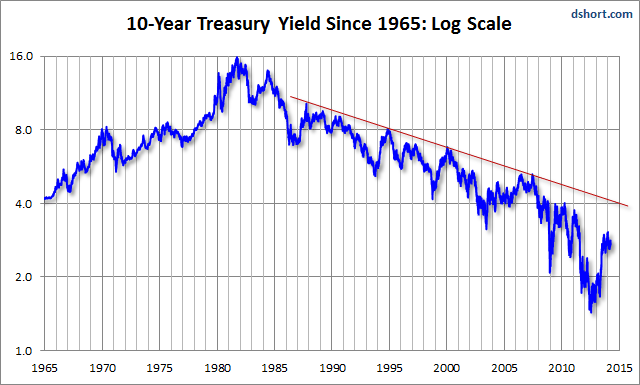
In recent years, the yield on the 10-year U.S. Treasury has fallen to unprecedented levels. In fact, the 10-year note reached an all-time low of 1.38% in July of 2012. That was the lowest level in 200 years.

For comparison, the all-time high of 15.84% was reached back in 1981.

Though the 10-year Treasury is currently yielding 2.69%, which is 95 percent higher than the record-low set nearly two years ago, it is still extraordinarily low by almost any measure.

Without some perspective, the above figures may seem trivial or inconsequential. In order to have some meaning, a little historical perspective is in order. So, I dug into the Treasury Department data and did a little research:

Over the 40-year period from 1974 to 2013, the yield on the 10-year Treasury averaged 6.89%.

Over the 30-year period from 1984 to 2013, the yield on the 10-year Treasury averaged 5.93%.

Over the 20-year period from 1994 to 2013, the yield on the 10-year Treasury averaged 4.60%.

Over the 10-year period from 2004 to 2013, the yield on the 10-year Treasury averaged 3.51%

Over the five-year period from 2009 to 2013, the yield on the 10-year Treasury averaged 2.68%.

So, the current yield is hovering right around that five-year average. But the trend is clear; the 10-year Treasury has been falling for the last few decades. And, as the following chart (courtesy of Doug Short) reveals, the rate has been in long term decline since the early 1980s.


However, we can also see that the ultra low rates of the past five years have pulled down those longer term averages quite a bit. In other words, the current period is clearly atypical of the past.

The lower yields in recent years have been a boon to home owners, who have benefitted from the correspondingly low 15- and 30-year mortgage rates.

But those low yields have also been of great benefit to the federal government, which has been able to borrow at exceptionally low rates to fund its deficit spending.

However, if the interest rate on the national debt rises to just the 20-year-average of 4.60 percent, an enormous portion of tax revenue would go toward paying the interest — leaving insufficient funds for healthcare, food stamps, bridges and roads, social security, or defense. You name it, and it would be either underfunded or unfunded.

The Congressional Budget Office (CBO) says it, "expects interest rates to rebound in coming years from their current unusually low levels, sharply raising the government’s cost of borrowing."

That's a troubling projection considering our $17.5 trillion national debt, as well as how much tax revenue the government currently spends servicing that debt.

The United States spends about $230 billion a year in finance payments to creditors. To put $230 billion a year in perspective, "It's more than the U.S. spends at the departments of Commerce, Education, Energy, Homeland Security, Interior, Justice, State and the court system combined," says Erskine Bowles, the Democratic co-chair of President Obama's National Commission on Fiscal Responsibility and Reform.

When rates inevitably rise to levels more in line with the 20-year average of 4.60 percent, the costs will be crippling. Again, the current yield of 2.69% is 58 percent lower than the 20-year average. That's a sobering perspective.

Again, remember that the current 10-year Treasury yield is already 95 percent higher than the all time low set less than two years ago. Yet, the yield is still low by historical standards. When rates are this low, even small increases make a big difference.

Very small absolute changes in interest rates are large proportionately when the primary interest rate is very low. That's why the market has been thrown into such turmoil over rather small changes in interest rates during the past year or so.

For example, if the 10-year Treasury moves from 2% to 2.50%, that half-point increase actually represents a proportionate increase of 25%, which is substantial.

However, when rates are at 5%, a half-point increase isn't as impacting.

Of course, the U.S. will pay its debts. The government will just have less money to pay for all the domestic needs that most of us perceive as vital to a highly functioning society — the kind of things we have come to think of as "normal" — such as healthcare, food stamps, bridges, roads, social security, defense, etc.

Such an outcome would negatively affect the broader economy.

As long as any government can continue to access the debt markets to fund its spending, it can conceivably continue deficit-spending in perpetuity without getting into too much trouble. It just needs to continually pay its creditors on schedule.

But if the debt markets become dubious about a government's ability to service its debts, that government would end up paying exorbitant interest rates to continue borrowing, which just makes its existing debt problem even worse. Think Greece.

Additionally, if debt service begins to occupy so much of a government's budget that it robs from critical government functions, then the debt level would begin to affect economic growth.

No matter how you slice it, when interest rates eventually rise to more traditional levels, it will create some really ugly scenarios.

Of course, this doesn't even begin to consider the fact that higher interest rates would affect all facets of our society and economy. The only ones that would benefit would be savers, which in itself would be a good thing.

It's just really important for all of us to consider where we are in the historical timeline, and that everything eventually reverts to the mean.

From January of 1962 to October of 2013, the 10-year Treasury note averaged 6.57 percent. It won't have to rise to even 5 percent to send shock waves throughout our economy and government.

What's behind these historically low rates? It's mostly a byproduct of the uncertainty in global markets and a flight to the perceived safety of U.S. Treasuries. The high demand drove down yields. When demand is high, the government doesn't have to induce people to lend it money. During times of economic uncertainty, investors are willing to leave their money tied up at low rates just to keep it safe.

Beginning in December 2008, the Federal Reserve set a target of 0.00 - 0.25% for the Federal Funds Rate, essentially an overnight lending rate for banks. The FFR is presently 0.08%, which essentially allows banks to borrow for free. The FFR affects short term rates, but it can also impact longer term interest rates.

The Federal Reserve does not control long-term interest rates. The market forces of supply and demand determine the pricing for long-term bonds, which set long-term interest rates. However, if the bond market believes that the Federal Reserve (FOMC) has set the Federal Funds Rate too low, expectations of future inflation increase. That, in turn, will typically increase long-term interest rates relative to short-term interest rates (a steepened yield curve).

So, though the Fed doesn’t control long-term rates, its policy with regard to short-term rates sets the basis for yields on government bonds with longer maturities.

This is all a great, big gamble. Investors have accepted these low returns just to keep their money safe during a prolonged period of economic uncertainty brought on by the Wall St. meltdown, the Great Recession, the eurozone debt crisis, and the fiscal cliff.

Ultimately, rates — both long term and short term — have nowhere to go but up. If the 10-year Treasury yield gradually doubles, reaching 5.38 percent, it would still be below its 30-year average of 5.93 percent. So, it's not an unrealistic scenario.

That wouldn't just upend the bond market; it would upend life as we know it in the U.S.

Wednesday, March 26, 2014

Too Few High Tech Jobs, Too Many Fast Food & Retail Jobs


Facebook recently bought WhatsApp — a company with just 55 employees — for $19 billion. It's rather stunning that a company with just 55 employees can be valued at $19 billion. What's more, the company had estimated revenues of just $20 million in 2013, which makes the purchase price seem all the more irrational.

The acquisition is indicative of the tremendous money and growth in the tech industry. There are so many high-paying jobs in the sector, and so many millionaires in Silicon Valley, that most people would surely love to work for one of the famous (or not so famous) tech companies in the area.

But, despite their sizable revenues and market capitalization, these companies employ a relatively small number of people. For example:

Apple employs 80,300 full-time employees, plus 4,100 full time temporary employees and contractors. However, 42,800 of its employees work in the retail part of the business.
Revenue: $170.9 billion
Market cap: $446 billion

Google employs 47,756 people.
Revenue: $59.82 billion
Market cap: $268.44 billion

LinkedIn employs 43,282 people.
Revenue: $1.52 billion
Market cap: $24.92 billion

Facebook had 6,337 employees as of December 31st.
Revenue: $7.87 billion
Market cap: $134 billion

Twitter had “over 2,300 employees” when it filed for its IPO late last year.
Revenue: $664 million
Market cap: $29.16 billion

In total, these five major technology companies — the likes of which almost everyone has heard of, and where virtually all young people would feel privileged to work — employ a total of roughly 137,000 people.

For comparison, here are America's 10 largest employers, each of which has a workforce of more than 300,000 people. Combined, they employ more than 5.6 million workers.

General Electric: 305,000 total employees
Hewlett-Packard: 331,800 total employees
Home Depot: 340,000 total employees
Kroger: 343,000 total employees
Target: 361,000 total employees
United Parcel Service: 399,000 total employees
IBM: 434,246 total employees
McDonald's: 440,000 total employees
Yum! Brands: (owner of KFC, Taco Bell and Pizza Hut) 523,000 total employees
Walmart: The largest American employer has 1.3 million workers employed in the United States.

The reality is that the workforce of many of these companies is part-time, temporary and seasonal, and many of these jobs are low-paying and poor quality. The bulk of the employees in at least six of these companies (Walmart, Home Depot, Kroger, Target, McDonald's and Yum! Brands) are low wage workers.

Unfortunately, each of these companies employs more than twice as many workers as the five combined technology companies listed above. And Walmart employes ten times as many.

That's a sobering perspective.

We would all benefit from an economy built on higher-wage workers in industries such as science, technology and engineering. But those are not the type of industries that employ the masses. Moreover, those industries all require advanced degrees.

A recent analysis by the National Employment Law Project shows that low-wage positions
account for nearly three out of five jobs generated in the first three years of economic recovery.

So, while America aspires to be a 21st Century global leader — with a workforce largely comprised of well-payed, highly-skilled workers in modern, first-world industries — our economy is bogged down by far too many fast food and retail jobs.

Of course, those are the kind of jobs that keep workers and their families in poverty and on public assistance.

We need more companies like Apple and Google all around the country, not just Silicon Valley, employing millions more people.

But what we have instead are way too many Walmarts, McDonald's and KFCs.

Wednesday, March 19, 2014

Great Recession Still Casting Its Shadow Over Employment/Wages


Perhaps the greatest and most lasting scar of the Great Recession has been its affect on employment and the job market. More jobs were wiped out in the Great Recession than in any other post-World War II downturn.

According to the Department of Labor, roughly 8.7 million jobs were shed from February 2008 through February 2010. Meanwhile, about 8.4 million jobs were created since February 2010. But the remaining deficit doesn't even account for all the high school and college graduates who have entered the workforce in that span.

It's a rather stunning state of affairs. Four years after our supposed recovery took hold, we still have a significant jobs deficit. Yet, the economy needs to add 143,000 jobs monthly just to keep pace with population growth.

More than three million students are expected to graduate from high school this year, according to the National Center for Education Statistics. Additionally, 943,000 students are expected to receive associate’s degrees this year, while 1.8 million more will earn bachelor's degrees.

As a result, millions of jobs will have to be created this year just to employ this group of graduates, which doesn't include all of the currently unemployed adults who are still searching for work. This same cycle has been playing out each and every year since the recession "officially" ended.

From the late 1940s until the early 1990s, the U.S. economy never took more than a year to regain all the jobs lost during downturns. Yet, after the 1990-91 recession, it took 21 months to recover all the lost jobs. And following the dot-com bubble, when 2.7 million jobs evaporated, it took 18 months after payrolls bottomed out for them all to come back.

The pattern is clear; it is taking longer and longer to recover from each subsequent recession. But the Great recession was a different animal altogether.

While the unemployment rate has been decreasing in recent years (despite the fact that it ticked back up to 6.7 percent in February), it masks some rather troubling underlying statistics.

The number of involuntary part-time workers was 7.2 million in February, according to the Bureau of Labor Statistics (BLS). These people were working part-time because their hours had been cut back or because they were unable to find full-time work.

In February, 2.3 million people were "marginally attached" to the labor force. These individuals were not in the labor force, wanted and were available for work, and had looked for a job sometime in the prior 12 months. They were not counted as unemployed because they had not searched for work in the four weeks preceding the survey.

The Labor Force Participation rate was 63 percent in February, meaning that just 63 percent of people in the civilian non-institutional population either had a job or were actively seeking one in the previous four weeks. This group includes all people in the United States, 16 or older, who are not on active duty in the military or in an institution, such as a prison, nursing home or mental hospital.

A rate this low has become a disturbing trend, and one that may not reverse.

The average annual labor force participation rate in 2013 was 63.2 percent, a 35-year-low, according to data from the BLS. The rate peaked at 67.1 percent in 1997 and has dropped annually ever since.

A Philadelphia Federal Reserve study on the topic notes that, “retirement had not played much of a role until around 2010.” By then, the rate had already dropped 2.4 percent.

This means that retirement has not played much of a role in the participation rates up until 2010, and it seems to be only marginally affecting it now.

Yes, older people are retiring, but younger workers are continually entering the workforce, which should be helping to offset those retirements. Additionally, older Americans are staying in the workforce longer than in the past, usually for financial reasons.

What's particularly alarming is that the participation rate for workers between ages 25 and 54 fell sharply during the recession and still hasn't recovered. So, the low participation rate is not simply a matter of older workers retiring.

Younger workers have been hit especially hard by unemployment, as well as low wages. Yet, older workers — 55 and older, even those 65 and older — have been adding to the labor force participation rate. They have fared much better than younger workers.

This suggests that the economy is in much worse shape than the official unemployment rate indicates. The official jobless rate (known as U-3) is currently 6.7 percent, but that only counts people who are actively seeking work — not labor-force dropouts.

The U-6 unemployment rate was 13.1 percent in February. This calculation includes: "discouraged workers", or those who have stopped looking for work because current economic conditions make them believe that no work is available for them; "marginally attached workers", or those who "would like" and are able to work, but have not looked for work recently; and part-time workers who want to work full-time, but cannot due to economic reasons (also known as "underemployment").

Here's a troubling fact: In February, there were more than 92 million Americans not in the labor force, a record number. However, there are just 144.1 million employed workers. This ratio is quite unsettling. It means that there are just 59 percent more adults working than not working.

In other words, there aren't even two adults working for every adult that isn't. That's rather stunning.

Of the nation's 144.1 million employed workers, about 27.8 million of them are part-time. This means roughly 19 percent of all workers are part-timers.

While part-time work typically increases during recessions, the percentage of part-time jobs has remained stubbornly high since the recession officially ended. As previously noted, there were 7.2 million involuntary part-time workers in February.

Though the BLS reports the economy has added private sector jobs for 48 straight months, and job growth has averaged 189,000 per month over the past 12 months, far too many of those jobs have been of the low-wage variety.

Roughly half of the jobs created in the United States in the past three years have been low-paying jobs, according to economists at the Royal Bank of Scotland, who sent a research note sent to their clients in May 2013 titled, "A Closer Look At The Labor Market Recovery."

RBS defines "low-paying" jobs as those paying 80 percent or less of the average private-sector wage of $20.04 per hour. The sectors providing many of these low-paying jobs include retail sales, leisure & hospitality, and education.

The RBS study echoes several others in recent years, including a National Employment Law Project study from August that found three-fifths of jobs created since the recession have been low-paying, roughly matching the number of middle-income jobs that were lost.

About a third of working families in the U.S., representing about 47 million people, are in low-wage jobs today, according to the Working Poor Families Project. That's startling.

So, even as the unemployment rate has been generally trending downward with the creation of new jobs, they are not the kind of jobs that can meaningfully drive demand and consumption in our economy. To the contrary, they are the kind of jobs that keep people in relative poverty.

In fact, the U.S. now has the highest proportion of low-wage workers in the developed world, according to the Organization for Economic Cooperation and Development. One in four make less than two-thirds of the median wage, which is the same proportion that relies on public aid.

The big picture reveals a national crisis. There simply aren't enough jobs to employ the long-term unemployed, as well as all of the recent high school and college graduates entering the workforce.

When you include the number of low-paying and part-time jobs to the mix, the situation is downright bleak.

This is no way to sustain an economy, much less grow one.

Friday, February 07, 2014

Economic Squeeze: Americans Don't Have Enough Income to Drive Demand


Our economic model is based on demand and consumption. In order for the economy to continually grow, people must continually buy more stuff.

Of course, there are the everyday staples that everyone will always buy because they must, such as food, toilet paper, tooth paste, soap, etc. Spending on these basic life-essentials is considered non-discretionary because there is no choice involved. Paying for the roof over one's head is also considered non-discretionary.

Yet, what businesses and the broader economy really need is for people to also make lots of discretionary purchases. This includes things such as household furniture, appliances, cars, luxury items, vacations and entertainment, plus all other non-essential goods and services.

The problem is that household income has been shrinking for many years, leaving people with less to spend.

For many years, Americans made up the difference by using credit cards and going into debt. In essence, people were spending money they didn't have to fiance their lifestyles. But people are now taking on less debt than during the bubble years.

For example, credit card debt outstanding is 7% lower than its level in 2010 and 16% below its peak in 2008.

The debt-to-income ratio for American households is now down to 109% – well below the peak of 135% reached in late 2007. But it's still 35 percentage points above the average of the final three decades of the twentieth century, according to Yale economist Stephen Roach.

In other words, Americans still have a lot of work to do to pay down their rather substantial debts.

The personal savings rate also remains below past levels. The savings rate fell to 4.48 percent in 2013, according to the Bureau of Economic Analysis.

After turning negative in 2005 for the first time since the Great Depression, and staying that way for about two years, the savings rate then began to climb, reaching a high of 6.1% in 2009.

After witnessing the collapse of the debt bubble, Americans were trying to pay down their debts as the financial crisis was still unfolding.

But the savings rate quickly returned to a downward trajectory the very next year, falling to 5.6 percent in 2010. It stayed relatively stable for the next two years: 5.7 percent in 2011, and 5.6 percent in 2012.

So, the decline to 4.48 percent in 2013 was rather substantial, amounting to a 20 percent drop.

As the Baby Boomers continue to retire each year and draw down on their retirement savings, the savings rate will be driven down even further.

There are a couple of different perspectives on the savings rate.

On the one hand, if people are saving, they are not spending, which tends to hold back economic growth. On the other hand, if people aren't saving, there is less money for national investment, meaning money is instead borrowed from overseas. As it stands, that's already a big problem for the U.S.

People haven't been able to save because they don't have the means. Incomes have fallen considerably. In past decades, people made up for that fact by going further into debt. This helped prop up economic growth. But there was an eventual and inevitable reckoning, as people came face to face with an enormous pile of debt that had become overwhelming.

So, Americans are now spending less now than in the bubble years of the last decade. Home equity has been crushed, leaving nothing for them to extract and spend.

This is all bad news for retailers and for the economy in general, since consumer spending accounts for more than 70 percent of GDP.

However, our economic decline was quite predictable. Real median household income is now at 1990 levels. Yes, that's how far backward the typical American household has fallen.

In 1970, the inflation-adjusted median household income was $45,146.
In 1980, the inflation-adjusted median household income was $46,024.
In 1990, the inflation-adjusted median household income was $49,950.
In 2000, the inflation-adjusted median household income was $54,841.
In 2010, the inflation-adjusted median household income was $50,831.

This means that household incomes barely budged for a couple of decades, and then they went backward in the last decade. Americans are making roughly the same amount today, in inflation-adjusted terms, as they were making back in 1990.

Yet, the problem of falling incomes stubbornly persists. Median household income after inflation fell again in 2011, to $50,054. After falling 0.5% in 2011, inflation-adjusted wages declined 0.4% in 2012.

Simply put, wages aren't keeping up with inflation.

Yet, the cost of everything continues to rise. For example, the price of gasoline over the last three years has been at its highest point ever. Gas prices in 2013 were the second highest in history, trailing only 2012, which saw the highest average price. And the third highest average price was in 2011.

Oil prices have surged from $25 per barrel in 2003 to $100 per barrel today. That has raised the cost of virtually everything in our economy. All goods that are transported are more costly as a result.

Outstanding student loan debt has reached a whopping $1.2 Trillion, which means that more than 40 million Americans are not buying houses or cars, starting businesses or families, or otherwise creating demand in the economy.

As previously noted, there are fewer people spending because they have less income to spend. But, additionally, there are fewer people working. The labor participation rate is at its lowest level in 35 years, a time when the economy was in recession.

There are 247 million working age Americans between the ages of 16 and 64 (those not in the military, jail/prison, mental facilities or homes for the aged). Only 155 million of them are employed. This means that 92 million working-age people are not working.

While some on these people are retiring, once someone turns 65 they are no longer counted in the work force. Yet, the number of 'working age' Americans is continually growing since thousands of teenagers turn 16 every day and are considered part of the labor force.

It's a sad fact that the labor force participation rate was just 62.8 in December. The figure hasn't been that low since at least 1978. Again, a whopping 92 million working age people simply aren't working.

The problem is there are too many people looking for too few jobs. At present, there are three applicants for every available job nationwide.

Then there's the additional problem of low-paying jobs. Nearly two out of three new jobs created from January through August last year were part time.

During the supposed recovery, there have been far more low-wage jobs created than high-wage jobs.

Between 2009 and 2013, low-wage jobs outnumbered high-wage jobs by some 800,000, with 1.7 million versus 1.1 million jobs. Though low-wage jobs made up less than one in five (19 percent) of all employment in 2009, they accounted for nearly 40 percent (39 percent) of all new jobs created out to 2013.

Put all these pieces together and you realize why demand and consumption are so low, and why economic growth has been so weak.

Growth rates in the U.S. have been decreasing for decades. In the 1950’s and 60’s, the average growth rate was above 4 percent. But in the 1970’s and 80’s, it dropped to around 3 percent. And in the last ten years, the average rate has been below 2 percent.

In fact, the U.S. economy has not surpassed 3 percent annual growth since 2005. Last year likely continued that trend. The advanced estimate for economic growth in 2013 is 2.7 percent, according to the White House. That number will be revised a couple of times in the coming months.

Think of it as the new normal.

There is, however, plenty of money still in the U.S. economy. It's just being siphoned off to the richest 1 percent.

The average CEO-to-worker pay ratio in 2012 was 354 to 1. That is far more than the ratio in other developed countries.

In the 1970s and early '80s, the U.S. ratio was roughly 20 to 1.

While most Americans continue to struggle financially, and even regress, the rich just keep getting richer.

The United States has led a worldwide growth in wealth concentration, according to a recent Oxfam report, titled "Working for the Few."

The percentage of income held by the richest 1% in the U.S. has grown by nearly 150% since 1980. That small elite has received 95% of wealth created since 2009, after the financial crisis, while the bottom 90% of Americans have become poorer, Oxfam said.

The new normal is plainly abnormal, even despicable.