Three more U.S. banks were closed on Friday, bringing the total number of bank failures this year to 133.
Apparently, things will get worse in 2010.
FDIC Chair Sheila Bair told CNBC that bank failures will continue to accelerate into next year despite "some encouraging signs" that things are turning around for the battered industry. Bair did not quantify how bad the failures would get, but said the worst isn't over yet for institutions that will suffer even as the economy improves:
The continuing bank failures will be driven by unusually high unemployment that is expected to lead to more foreclosures and other commercial loan failures.
So far, the total cost of the 133 failures to the FDIC fund is more than $28 billion.
The FDIC recently announced that 552 banks are at risk of going under.
Wednesday, December 16, 2009


Tuesday, December 08, 2009
Horizontal Drilling Expands Natural Gas Reserves

Using a relatively new new technique, oil engineers and geologist are now able to drill horizontally to extract natural gas from shale.
The technique has been used across Texas, Oklahoma, Louisiana and Pennsylvania for the past decade, resulting in a 40 percent increase in U.S. natural gas supplies in recent years.
The increased production has created a glut of the gas in the U.S., helping to drive down gas prices and utility costs.
Daniel Yergin, chairman of IHS Cambridge Energy Research Associates, calls the new method of producing gas “is the biggest energy innovation of the decade.”
Natural gas produces fewer emissions of greenhouse gases than either oil or coal, making it a favorable alternative.
Now Europe is seeking to expand in its reserves of the cleanest fossil fuel. The hope is that the continent can reduce its dependence on Russian natural gas.
Initial estimates of recoverable shale gas in Europe range up to 400 trillion cubic feet. Though that is less than half the industry’s estimates of what is recoverable in the United States, it could eventually drive down prices, which are sometimes twice as high as those in the U.S.
By some estimates, the horizontal drilling technique could result in at least a 20 percent increase in the world’s known reserves of natural gas.
One recent study by the Cambridge consulting group, calculated that the recoverable shale gas outside of North America could turn out to be equivalent to 211 years’ worth of natural gas consumption in the United States at the present level of demand, and maybe as much as 690 years.
The low figure would represent a 50 percent increase in the world’s known gas reserves, and the high figure, a 160 percent increase.
If the U.S. can convert more of its transportation fleets to use natural gas rather than gasoline, it would increase energy independence and security, as well as reducing costs and carbon emissions.
On a global scale, those benefits would obviously be greatly magnified.
Amidst all the dire peak oil news, this at least provides us with some semblance of hope.
Monday, December 07, 2009
Number of Failed U.S. Banks Reaches 130, and Counting
Six more U.S. banks were closed on Friday. These latest failures are expected to cost the FDIC's insurance fund at least $2.3 billion.
A total of 130 U.S. banks have now failed this year. The cumulative cost of all these failures to the federal deposit insurance fund is more than $28 billion, and counting.
The problem is that this fund has been in the red for over two months.
Last week, the FDIC announced that 552 banks are at risk of going under.
This begs the question: Is your bank safe?
The FDIC is counting on struggling banks to pay three years worth of insurance fund fees (amounting to $45 billion) to help offset the continuing losses.
Yes, the FDIC is relying on insolvent banks to come up with money they don't have, in order to save themselves.
It boggles the mind.
A total of 130 U.S. banks have now failed this year. The cumulative cost of all these failures to the federal deposit insurance fund is more than $28 billion, and counting.
The problem is that this fund has been in the red for over two months.
Last week, the FDIC announced that 552 banks are at risk of going under.
This begs the question: Is your bank safe?
The FDIC is counting on struggling banks to pay three years worth of insurance fund fees (amounting to $45 billion) to help offset the continuing losses.
Yes, the FDIC is relying on insolvent banks to come up with money they don't have, in order to save themselves.
It boggles the mind.
Friday, December 04, 2009
Declining Job Losses Nothing to Celebrate
The good economic news today was that the economy only shed 11,000 jobs in November, giving Wall St. cause for celebration.
However, it was the 23rd consecutive month of job losses – the longest losing streak since the 1930s.
Indeed, jobs losses must decelerate before ceasing, and losses must cease before net job creation is realized. But amid all this hubbub, one thing cannot be overlooked: the U.S. economy is still losing jobs every month.
Two years since the start of the Great Recession, nearly 8 million jobs have been lost. In fact, all job creation for the entire decade has been destroyed and is now negative. That hasn't happened since the Great Depression of the 1930s.
The fact is, there are twice as many unemployed people today as there were two years ago at his time.
Though the labor market has seen a steady decline in first-time jobless claims, and Initial claims have fallen five weeks in a row, it's not the layoffs that are hurting us as much as the lack of hiring.
In essence, while fewer people are being laid off, fewer are being hired as well.
Nearly six million of the 15.7 million people officially classified as unemployed have been out of work longer than six months. And that doesn't count the part-timers who cannot find full-time work, or those who have simply given up looking.
About 2.3 million persons were not in the labor force, wanted and were available for work, and had looked for a job sometime in the prior 12 months. They were not counted as unemployed because they had not searched for work in the 4 weeks preceding the survey.
There are 9.28 million people working part time, but who want a full time job. A year ago the number was 7.3 million. Employers will start increasing the hours of part-time workers before they start hiring full-time workers. This should give us pause.
Truthfully, all of these facts should temper some of the jubilation about a potential recovery.
The so-called U-6 unemployment figure still remains above 17%. This figure counts all the people that want a job but gave up, all the people with part-time jobs that want a full-time job, all the people who dropped off the unemployment rolls because their unemployment benefits ran out, etc.
Many of these job losses will be permanent. Millions of Americans will have to find new jobs or even new careers, which will be a lengthy process. The economy is both restructuring and recovering at the same time.
Service-producing industries added 58,000 jobs, while goods-producing industries cut 69,000 jobs. This is exactly the wrong kind of job creation, and the continuation of a decades-long pattern.
For far too long we've consumed too much and produced too little. We need to recover our manufacturing base in a hurry.
Unfortunately, there are continually fewer high-skill, high-paying jobs. In their place are evermore low-skill, low-paying service jobs.
"Hi, welcome to Wal-Mart," and "Hello, welcome to McDonald's, can I take your order?" have become all too common refrains for far too many educated and overqualified workers.
According to Lawrence Katz, a labor economist at Harvard, for every job that becomes available, about six people are looking. That creates an enormous amount of competition and leaves many out of luck.
Here's the reality check:
The government says that 1.3 million jobs need to be created every year from 2006-2016 just to keep up with the growing labor force. The hole we're in is very deep. Experts note that it will take years to reverse these massive losses.
Even if the nation could add 2.15 million private-sector jobs per year starting in January 2010, it would need to maintain this pace for more than 7 straight years (7.63 years), or until August 2017, to eliminate the current jobs deficit.
Washington, Wall St. and the mainstream media should hold of on the celebrating for now. The recovery hasn't really started yet. And whenever it does, there's still a very long road ahead.
However, it was the 23rd consecutive month of job losses – the longest losing streak since the 1930s.
Indeed, jobs losses must decelerate before ceasing, and losses must cease before net job creation is realized. But amid all this hubbub, one thing cannot be overlooked: the U.S. economy is still losing jobs every month.
Two years since the start of the Great Recession, nearly 8 million jobs have been lost. In fact, all job creation for the entire decade has been destroyed and is now negative. That hasn't happened since the Great Depression of the 1930s.
The fact is, there are twice as many unemployed people today as there were two years ago at his time.
Though the labor market has seen a steady decline in first-time jobless claims, and Initial claims have fallen five weeks in a row, it's not the layoffs that are hurting us as much as the lack of hiring.
In essence, while fewer people are being laid off, fewer are being hired as well.
Nearly six million of the 15.7 million people officially classified as unemployed have been out of work longer than six months. And that doesn't count the part-timers who cannot find full-time work, or those who have simply given up looking.
About 2.3 million persons were not in the labor force, wanted and were available for work, and had looked for a job sometime in the prior 12 months. They were not counted as unemployed because they had not searched for work in the 4 weeks preceding the survey.
There are 9.28 million people working part time, but who want a full time job. A year ago the number was 7.3 million. Employers will start increasing the hours of part-time workers before they start hiring full-time workers. This should give us pause.
Truthfully, all of these facts should temper some of the jubilation about a potential recovery.
The so-called U-6 unemployment figure still remains above 17%. This figure counts all the people that want a job but gave up, all the people with part-time jobs that want a full-time job, all the people who dropped off the unemployment rolls because their unemployment benefits ran out, etc.
Many of these job losses will be permanent. Millions of Americans will have to find new jobs or even new careers, which will be a lengthy process. The economy is both restructuring and recovering at the same time.
Service-producing industries added 58,000 jobs, while goods-producing industries cut 69,000 jobs. This is exactly the wrong kind of job creation, and the continuation of a decades-long pattern.
For far too long we've consumed too much and produced too little. We need to recover our manufacturing base in a hurry.
Unfortunately, there are continually fewer high-skill, high-paying jobs. In their place are evermore low-skill, low-paying service jobs.
"Hi, welcome to Wal-Mart," and "Hello, welcome to McDonald's, can I take your order?" have become all too common refrains for far too many educated and overqualified workers.
According to Lawrence Katz, a labor economist at Harvard, for every job that becomes available, about six people are looking. That creates an enormous amount of competition and leaves many out of luck.
Here's the reality check:
The government says that 1.3 million jobs need to be created every year from 2006-2016 just to keep up with the growing labor force. The hole we're in is very deep. Experts note that it will take years to reverse these massive losses.
Even if the nation could add 2.15 million private-sector jobs per year starting in January 2010, it would need to maintain this pace for more than 7 straight years (7.63 years), or until August 2017, to eliminate the current jobs deficit.
Washington, Wall St. and the mainstream media should hold of on the celebrating for now. The recovery hasn't really started yet. And whenever it does, there's still a very long road ahead.
Thursday, December 03, 2009
Worldwide Economic Instability a Major Threat
The U.S. Director of National Intelligence, Dennis Blair, has told Congress that instability in countries around the world caused by the global economic crisis and its geopolitical implications, rather than terrorism, is the primary near-term security threat to the United States.
And another leading figure on the world stage has voiced similar concerns.
In March, Dominique Strauss-Kahn, the head of the International Monetary Fund, warned that the global economic crisis threatened millions of people with being pushed into poverty.
At a meeting of the International Labour Organisation, Mr Strauss-Kahn issued this warning:
"'Bluntly the situation is dire. All this will affect dramatically unemployment. And, beyond unemployment, for many countries it will be at the roots of social unrest, some threat to democracy, and maybe for some cases it can also end in war."
He also warned governments against ploughing even more fiscal stimulus into their ailing economies.
"You can put in as much stimulus as you want. It will just melt in the sun as snow if at the same time you are not able to have a generally smaller financial sector than before, but a healthy financial sector at work."
The Federal Reserve didn't heed the warning; instead it has increased the monetary base by 142% over the last two years.
Meanwhile, bank balance sheets continue to deteriorate as home foreclosures spiral, and as the commercial real estate collapse gains momentum.
And people are noticing.
Standard & Poor’s has given warning that nearly all of the world’s big banks lack sufficient capital to cover trading and investment exposure, risking further downgrades over the next 18 months unless they move swiftly to beef up their defences.
Every single bank in Japan, the US, Germany, Spain, and Italy included in S&P’s list of 45 global lenders fails the 8pc safety level under the agency’s risk-adjusted capital (RAC) ratio. Most fall woefully short.
And then there's the Dubai default / debacle, which sent a shockwaves through markets around the world. Dubai is likely the canary in the coal mine, signaling the weakness of the global financial system, and the limits of debt.
It appears that 2010 isn't shaping up to be a very happy new year.
And another leading figure on the world stage has voiced similar concerns.
In March, Dominique Strauss-Kahn, the head of the International Monetary Fund, warned that the global economic crisis threatened millions of people with being pushed into poverty.
At a meeting of the International Labour Organisation, Mr Strauss-Kahn issued this warning:
"'Bluntly the situation is dire. All this will affect dramatically unemployment. And, beyond unemployment, for many countries it will be at the roots of social unrest, some threat to democracy, and maybe for some cases it can also end in war."
He also warned governments against ploughing even more fiscal stimulus into their ailing economies.
"You can put in as much stimulus as you want. It will just melt in the sun as snow if at the same time you are not able to have a generally smaller financial sector than before, but a healthy financial sector at work."
The Federal Reserve didn't heed the warning; instead it has increased the monetary base by 142% over the last two years.
Meanwhile, bank balance sheets continue to deteriorate as home foreclosures spiral, and as the commercial real estate collapse gains momentum.
And people are noticing.
Standard & Poor’s has given warning that nearly all of the world’s big banks lack sufficient capital to cover trading and investment exposure, risking further downgrades over the next 18 months unless they move swiftly to beef up their defences.
Every single bank in Japan, the US, Germany, Spain, and Italy included in S&P’s list of 45 global lenders fails the 8pc safety level under the agency’s risk-adjusted capital (RAC) ratio. Most fall woefully short.
And then there's the Dubai default / debacle, which sent a shockwaves through markets around the world. Dubai is likely the canary in the coal mine, signaling the weakness of the global financial system, and the limits of debt.
It appears that 2010 isn't shaping up to be a very happy new year.
Monday, November 30, 2009
The High Cost of Dying

In 2008, Medicare paid $50 billion just for doctor and hospital bills during the last two months of patients' lives. That's more than the budgets of the Department of Homeland Security or the Department of Education.
There's an important distinction to be made here; this spending wasn't geared toward saving lives. All of these patients died within two months.
Such a protocol isn't a matter of prolonging life; it's a matter of prolonging death.
According to Dr. Ira Byock, 18 to 20 percent of Americans spend their last days in an ICU.
Despite the fact that a vast majority of Americans say they want to die at home, 75 percent end up dying in a hospital or a nursing home.
Dr. Elliott Fisher, a researcher at the Dartmouth Institute for Health Policy, says that 30 percent of hospital stays in the United States are probably unnecessary.
The resulting costs are massive.
Overall, healthcare in the U.S. is the most expensive in the world, costing about $2.4 trillion last year.
And government economists expect healthcare costs to account for 17.6 percent of GDP this year.
Part of the problem is that most doctors get paid based on the number of patients they see, and most hospitals get paid for the patients they admit. This amounts to what might be termed a "perverse incentive."
"In medicine we have turned the laws of supply and demand upside down," says Dr. Fisher. "Supply drives its own demand. If you're running a hospital, you have to keep that hospital full of paying patients in order to, you know, to meet your payroll. In order to pay off your bonds."
In essence, the current system often rewards excessive care. Efficacy and outcomes are not rewarded. But excessive care is.
By law, Medicare cannot reject any treatment based upon cost. It will pay $55,000 for patients with advanced breast cancer to receive the chemotherapy drug Avastin, even though it extends life only by an average of one and a half months.
And it will pay $40,000 for a 93-year-old man with terminal cancer to get a surgically implanted defibrillator if he happens to have heart problems too.
On a national basis, the costs are enormous.
Projections released by economists at the Centers for Medicare and Medicaid show health care outlays rising from $2.4 trillion in 2008 to $4.4 trillion by 2018, or 20.3 percent of the GDP.
Comparatively, healthcare costs are considerably less expensive across the industrialized world, ranging from 7.2 percent of GDP in Ireland to 11.6 percent in Switzerland.
The current level of U.S. spending is simply unsustainable.
David Walker, the government's former top accountant, puts it this way:
"The one thing that could bankrupt America is out of control health care costs. And if we don't get them under control, that's where we're headed."
Sunday, November 29, 2009
One in Eight Americans Now Receiving Food Stamps

The use of food stamps has reached a record high and is climbing every month.
Due to the recession, the number of recipients has soared. One in eight Americans, and one in four children, are now fed by food stamps. That amounts to more than 36 million people.
Virtually all have incomes near or below the federal poverty line, and include single mothers and married couples, the unemployed, the chronically poor, longtime recipients of welfare checks, and workers facing reduced hours and/or low wages.
Almost 90 percent of food stamp beneficiaries live below the poverty line.
However, the federal poverty level has a very conservative definition, and is set according to the number of persons in a family.
1 person: $10,830
2 people: $14,570
3 people: $18,310
4 people: $22,050
Individuals earning $11,000 annually are not considered in poverty. And the government does not define a family of four subsisting on $23,000 as living in poverty either.
Despite the strict definitions of poverty, the number of people receiving "nutritional assistance" has been steadily rising. The program is currently expanding at a rate of 20,000 people every day.
The stigma once associated with food stamps has eroded, and even large numbers of "red state" voters are beneficiaries.
In fact, the food stamp program is now officially known as the Supplemental Nutrition Assistance Program, or SNAP.
For many recipients, that acronym probably has a much nicer ring to it than "food stamps" ever did.
While the number of recipients of the federal cash welfare program has remained flat, the number of food stamp recipients has been steadily climbing.
According to an analysis done by the New York Times, there are 239 U.S. counties where at least a quarter of the population now receives food stamps.
And in 205 counties, the number of people receiving food stamps has risen by at least two-thirds since the recession started two years ago.
Yet, incredibly, the program will almost surely grow considerably larger; only two-thirds of eligible recipients are presently enrolled nationwide.
As it stands, roughly 12 percent of Americans receive food aid.
Professor Mark Rank, of Washington University, recently found that half of Americans receive food stamps at some point by the age of 20.
In Ohio alone, the cost of food stamps to the federal government was $2.2 billion last year. That's just a microcosm of the larger national cost.
According to the government, in 2008, SNAP served 28.4 million people a month at an annual cost of $34.6 billion.
But since that time, the ranks of recipients have swelled by some six million people.
And with it, so have the costs.
Saturday, November 21, 2009
Bank Failures Continue to Mount
As of November 20, a total of 124 U.S. banks have been closed by regulators. That's the highest total since 1992, when 181 banks failed at the tail end of the S&L crisis.
An average of 11 banks per month have failed this year. Just 25 banks failed last year, and only three in 2007.
The 124 closings have cost the FDIC's insurance fund more than $28 billion this year. The fund's balance went negative as of the end of the third quarter.
The FDIC estimates that the total cost of failures will be $100 billion from 2009 through 2013.
The number of banks on the FDIC's "problem list" stood at 416 at the end of June. The agency will hold a briefing next week to reveal how many banks are currently on that problem list.
The FDIC says that bank failures will remain elevated through next year. Experts suggest we could be no more than 10% of the way through this cycle of bank collapses.
CreditSights, which tracks bank failures, predicts that in the current cycle, from 2008 through 2011, as many as 1,100 banks will fail. That would wipe out 13.4% of all U.S. banks, representing 7% of U.S. banking assets.
Most of the troubled banks are concentrated at the regional and community level, and are weighed down by commercial real estate and construction loans.
Between now and 2012, more than $1.4 trillion worth of commercial real estate loans will come due, according to real estate investment firm ING Clarion Partners.
However, the collateral value underlying many of these loans is depreciating. That means many borrowers will have trouble rolling over their loans.
"Another wave of prolonged losses driven by weakness in commercial real estate could prove catastrophic to many of these weakened banks," CreditSights said.
The banking system has deteriorated considerably since last fall. Banks that regulators deemed healthy only months ago have started to fail.
This month, three banks that received taxpayer money have failed. The three received a total of $2.63 billion from the $700 billion financial bailout program. All of that taxpayer money will likely be lost.
When the TARP legislation was enacted last October, then-Treasury Secretary Henry Paulson said, "there is no reason to expect this program will cost taxpayers anything."
In all, more than two dozen banks that received taxpayer money have faced regulatory actions, suggesting they are not stable and could fail. All were deemed "healthy banks" when that money was granted.
More than $5 billion in taxpayer money could be lost, depending on which of these shaky banks survive.
Hold on to your hats, your checkbooks, and your wallets; the worst is yet to come.
An average of 11 banks per month have failed this year. Just 25 banks failed last year, and only three in 2007.
The 124 closings have cost the FDIC's insurance fund more than $28 billion this year. The fund's balance went negative as of the end of the third quarter.
The FDIC estimates that the total cost of failures will be $100 billion from 2009 through 2013.
The number of banks on the FDIC's "problem list" stood at 416 at the end of June. The agency will hold a briefing next week to reveal how many banks are currently on that problem list.
The FDIC says that bank failures will remain elevated through next year. Experts suggest we could be no more than 10% of the way through this cycle of bank collapses.
CreditSights, which tracks bank failures, predicts that in the current cycle, from 2008 through 2011, as many as 1,100 banks will fail. That would wipe out 13.4% of all U.S. banks, representing 7% of U.S. banking assets.
Most of the troubled banks are concentrated at the regional and community level, and are weighed down by commercial real estate and construction loans.
Between now and 2012, more than $1.4 trillion worth of commercial real estate loans will come due, according to real estate investment firm ING Clarion Partners.
However, the collateral value underlying many of these loans is depreciating. That means many borrowers will have trouble rolling over their loans.
"Another wave of prolonged losses driven by weakness in commercial real estate could prove catastrophic to many of these weakened banks," CreditSights said.
The banking system has deteriorated considerably since last fall. Banks that regulators deemed healthy only months ago have started to fail.
This month, three banks that received taxpayer money have failed. The three received a total of $2.63 billion from the $700 billion financial bailout program. All of that taxpayer money will likely be lost.
When the TARP legislation was enacted last October, then-Treasury Secretary Henry Paulson said, "there is no reason to expect this program will cost taxpayers anything."
In all, more than two dozen banks that received taxpayer money have faced regulatory actions, suggesting they are not stable and could fail. All were deemed "healthy banks" when that money was granted.
More than $5 billion in taxpayer money could be lost, depending on which of these shaky banks survive.
Hold on to your hats, your checkbooks, and your wallets; the worst is yet to come.
Tuesday, November 17, 2009
Hunger Growing Across U.S.

That was an increase from 13 million households, or 11 percent, in 2008.
This is a disturbing development, and amounts to the highest total since the government began surveying in 1995. It points to the distress that millions of American families are facing as a result of the recession.
In its simplest terms, what this means is that one in seven households is now struggling to put enough food on the table.
Agriculture Secretary Tom Vilsack called hunger “a problem that the American sense of fairness should not tolerate and American ingenuity can overcome.”
However, Vicki Escarra, president of the nonprofit organization Feeding America, says the Agriculture Department is probably understating the problem.
Food banks in her network reported an average increase in need of nearly 30 percent this year over 2008.
It would hardly be a surprise if the government is fudging the numbers; it recently admitted it had overestimated employment figures by 824,000 jobs between March of 2008 and March of 2009.
Food — the most basic staple of life, and of dignity — is simply unaffordable for millions of Americans.
The government reports that one in eight Americans now collects food stamps.
This is a stunning figure. And that number will continue to grow; nearly 16 million Americans are now said to be unemployed, and more than 100,000 additional people join their ranks each week.
When workers who can only find part time jobs are added to the mix, we find that 26.5 million Americans are either unemployed or under-employed.
Sadly, their is no letup in sight.
We are living in hard times and this latest Agriculture Report only serves to remind us that, for millions of Americans, the basic act of buying food has become all too challenging.
For these families, the recession is anything but over.
Monday, November 16, 2009
Military Spending Weighs Heavily on Bloated Budget
Research Shows That it is Robbing Jobs From the Private Sector Too
 With the National Debt about to exceed $12 Trillion (which will require Congressional approval), major budget cuts will most certainly ensue and significant tax hikes won't be far behind.
But much of the federal budget is mandated by law — the product of Social Security and Medicare — or is otherwise non-discretionary, such as interest payments to holders of the U.S. debt.
The War Research League performed an analysis of the “Analytical Perspectives” book of the Budget of the United States Government, Fiscal Year 2009.
It found that 54% of federal spending is allocated to the military. This includes veterans spending, the cost of the "war on terror", as well as the cost of two concurrent wars.
The Center for Defense Information reports the military portion of the budget at 51%.
Either way, military spending represents more than half the federal budget.
The Center for Economic and Policy Research published an op-ed last week titled, Massive Defense Spending Leads to Job Loss.
The piece notes that defense spending removes resources from the economy, thwarting the free market. Defense spending is a direct drain on the economy, reducing efficiency, slowing growth and costing jobs.
A few years ago the Center for Economic and Policy Research commissioned Global Insight, one of the leading economic modeling firms, to project the impact of a sustained increase in defense spending equal to 1.0 percentage point of GDP. This was roughly equal to the cost of the Iraq War.
Global Insight’s model projected that after 20 years the economy would be about 0.6 percentage points smaller as a result of the additional defense spending. Slower growth would imply a loss of almost 700,000 jobs compared to a situation in which defense spending had not been increased.
Defense spending has now grown to 5.6 percent of GDP. By comparison, before the September 11th attacks, the Congressional Budget Office projected that defense spending in 2009 would be equal to just 2.4 percent of GDP. That's a difference of 3.2 percent. So, the Global Insight projections of job loss are far too low.
In fact, the projected job loss from this increase in defense spending is closer to 2 million. The analysis also projects a roughly $250 billion reduction in GDP due to defense spending. This is at the expense of the private sector.
Upon his departure from the White House, President Eisenhower so famously warned of the dangers of the Military-Industrial Complex.
Useless, unwanted, unwarranted, and unnecessary weapons systems are continually approved and appropriated. The entire defense-contracting industry has dedicated itself to forever increasing government spending on its assorted wares.
About $50 billion in defense spending (or about 7.5%) is now classified, or part of the so-called "black budget."
According to Aviation Week’s Bill Sweetman, this makes the Pentagon’s secret operations, including the intelligence budgets nested inside, “roughly equal in magnitude to the entire defense budgets of the UK, France or Japan.”
While America debates how soon we can bring home our troops from Iraq, it's worth noting that — more than 60 years after the end of WWII — the US still has more than 50,000 troops in Germany and 30,000 in Japan.
In fact, the US has over 500,000 military personnel deployed on over 700 bases, with troops in 150 countries — including 37 European nations.
As Ron Paul suggests, in this time of deep economic crisis, why not just bring them all home?
"We are bankrupt and cannot afford it," says the Texas Representative.
The truth is, he's right.

But much of the federal budget is mandated by law — the product of Social Security and Medicare — or is otherwise non-discretionary, such as interest payments to holders of the U.S. debt.
The War Research League performed an analysis of the “Analytical Perspectives” book of the Budget of the United States Government, Fiscal Year 2009.
It found that 54% of federal spending is allocated to the military. This includes veterans spending, the cost of the "war on terror", as well as the cost of two concurrent wars.
The Center for Defense Information reports the military portion of the budget at 51%.
Either way, military spending represents more than half the federal budget.
The Center for Economic and Policy Research published an op-ed last week titled, Massive Defense Spending Leads to Job Loss.
The piece notes that defense spending removes resources from the economy, thwarting the free market. Defense spending is a direct drain on the economy, reducing efficiency, slowing growth and costing jobs.
A few years ago the Center for Economic and Policy Research commissioned Global Insight, one of the leading economic modeling firms, to project the impact of a sustained increase in defense spending equal to 1.0 percentage point of GDP. This was roughly equal to the cost of the Iraq War.
Global Insight’s model projected that after 20 years the economy would be about 0.6 percentage points smaller as a result of the additional defense spending. Slower growth would imply a loss of almost 700,000 jobs compared to a situation in which defense spending had not been increased.
Defense spending has now grown to 5.6 percent of GDP. By comparison, before the September 11th attacks, the Congressional Budget Office projected that defense spending in 2009 would be equal to just 2.4 percent of GDP. That's a difference of 3.2 percent. So, the Global Insight projections of job loss are far too low.
In fact, the projected job loss from this increase in defense spending is closer to 2 million. The analysis also projects a roughly $250 billion reduction in GDP due to defense spending. This is at the expense of the private sector.
Upon his departure from the White House, President Eisenhower so famously warned of the dangers of the Military-Industrial Complex.
Useless, unwanted, unwarranted, and unnecessary weapons systems are continually approved and appropriated. The entire defense-contracting industry has dedicated itself to forever increasing government spending on its assorted wares.
About $50 billion in defense spending (or about 7.5%) is now classified, or part of the so-called "black budget."
According to Aviation Week’s Bill Sweetman, this makes the Pentagon’s secret operations, including the intelligence budgets nested inside, “roughly equal in magnitude to the entire defense budgets of the UK, France or Japan.”
While America debates how soon we can bring home our troops from Iraq, it's worth noting that — more than 60 years after the end of WWII — the US still has more than 50,000 troops in Germany and 30,000 in Japan.
In fact, the US has over 500,000 military personnel deployed on over 700 bases, with troops in 150 countries — including 37 European nations.
As Ron Paul suggests, in this time of deep economic crisis, why not just bring them all home?
"We are bankrupt and cannot afford it," says the Texas Representative.
The truth is, he's right.
Saturday, November 14, 2009
Monumental Oil Scam Robbing Consumers Every Day

Investor and consultant Phillip Davis has written about a giant global oil scam amounting to some $2.5 TRILLION.
Davis notes that investment giants Goldman Sachs, Morgan Stanley, Deutsche Bank and Societe Generale teamed with oil giants British Petroleum, Total, and Shell to found the Intercontinental Exchange (ICE) in 2000.
The ICE is putting billions of dollars into oil futures contracts without ever taking delivery of the oil. It's nothing more than a shell game.
"They just ratchet up the price with leveraged speculation using your TARP money," writes Davis. "This year alone they ratcheted up the global cost of oil from $40 to $80 per barrel."
In 2003, Congress discovered that ICE was facilitating "roundtrip trades," in which one firm sells energy to another and then the second firm simultaneously sells the same amount of energy back to the first company at exactly the same price. No commodity ever changes hands.
This indicates demand to the market, which pushes up the price. Yet, it amounts to nothing more than smoke and mirrors.
Over the course of an average month, 5 BILLION barrels of oil are traded on the NYMEX. A fee is collected on every single transaction, and this is ultimately passed down to US consumers. Yet, less than 40M barrels is actually delivered. That is just 8 tenths of 1 percent of actual demand for the product being traded. So, 99.2% of the oil transaction fees being paid by the American people amount to nothing more than fees for traders and record profits and bonuses for the trading firms.
"Before ICE, the average American family spent 7% of their income on food and fuel," writes Davis.."Last year, that number topped 20%. That’s 13% of the incomes of every man, woman and child in the United States of America, over $1 Trillion EVERY SINGLE YEAR, stolen through market manipulation. On a global scale, that number is over $4 Trillion per year."
This amounts to a truly massive scam, an epic scam.
ICE members Total and JP Morgan are currently storing 125 million barrels of oil in offshore tankers. That amounts to 15 days of US imports that have been ordered, but not delivered.
Speculators have stockpiled the equivalent of 1.1 million barrels of oil via the futures market. That amounts to eight times the amount added to the Strategic Petroleum Reserve over the last five years.
There is an extraordinary amount of manipulation going on in the oil markets, and consumers the world over are being gouged by all of this illicit behavior.
There is no oversight and no regulation. We're all being robbed.
Back in January, 60 Minutes ran a similar story, noting that oil speculation seemed to be fueling wild swings in oil prices. That can be seen here.
To read Davis' article, click here.
Wednesday, November 11, 2009
World Oil Reserves Running Out Much Faster Than Previously Believed
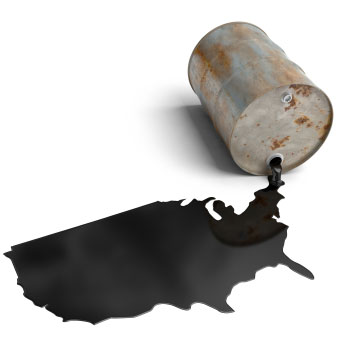
A whistleblower from the International Energy Association (IEA) has told the Guardian UK that the agency has been deliberately misleading the public about oil reserves in order to avert a panic on world markets.
The senior official, who was unwilling to be identified for fear of reprisals inside the industry, says the US encouraged the IEA to underestimate the decline in worldwide oil reserves while overestimating the potential for new reserves.
World oil production is currently 83 million barrels a day. Since 2005, the IEA has had to downwardly asses its projections for 2030 from 120 millions barrels per day to 116, and then to 105.
But even that is highly inflated, according to the official.
"Many inside the organisation believe that maintaining oil supplies at even 90m to 95m barrels a day would be impossible but there are fears that panic could spread on the financial markets if the figures were brought down further. And the Americans fear the end of oil supremacy because it would threaten their power over access to oil resources," he told the British paper.
A second IEA source, no longer with the agency, backed his former colleague's claims. "We have [already] entered the 'peak oil' zone. I think that the situation is really bad," he said.
The implications for the US and the rest of the industrial world are stark.
International observers have long suspected that the IEA's projections for future oil output were misleading.
Yet last summer, the IEA's chief economist publicly stated that most of the world's major oil fields have already passed their peak production.
Dr Fatih Birol said the world is heading for a catastrophic energy crunch because oil is running out far faster than previously predicted. He noted that global production is likely to peak in about 10 years.
The Guardian's latest report reveals this projection to be overly optimistic.
The first detailed assessment of more than 800 oil fields in the world, covering three quarters of global reserves, found that most of the biggest fields have already peaked and that the rate of decline in oil production is now 6.7%.
It's worth noting that the doubling rate of 7% is 10 years. In other words, anything growing or shrinking by 7% will see a doubling effect in 10 years.
In its landmark assessment of the world's major oil fields, the IEA concluded that global consumption of oil was "patently unsustainable", with expected demand far outstripping supply.
Dr Birol said that even if demand remained steady, the world would have to find the equivalent of four Saudi Arabias to maintain production, and six Saudi Arabias if it is to keep up with the expected increase in demand between now and 2030.
That assessment was quite sobering. But in light of the new warning from the IEA whistleblowers, the future of oil production and supply appears downright scary.
It seems that production will in no way be able to meet growing world demand, and that our lives in the heavily oil-dependent modern economy are simply unsustainable and need to change quickly.
Eventually, there will be major disruptions and shortages. Such events will cripple the world economy and radically alter our way of life.
In a grim and perhaps tacit warning last summer, Dr. Birol said the following:
"One day we will run out of oil. It is not today or tomorrow, but one day we will run out of oil. And we have to leave oil before oil leaves us. And we have to prepare ourselves for that day. The earlier we start, the better, because all of our economic and social system is based on oil. So to change from that will take a lot of time and a lot of money and we should take this issue very seriously."
Monday, November 09, 2009
Bank Stresses Mounting; Commercial Real Estate Crisis Looming
As if mounting residential housing defaults weren't enough of a problem, banks are expected to face an even bigger crisis next year: commercial real estate defaults.
Banks hold roughly $1.8 trillion of commercial real estate debt on their books. Many of those loans were made in the same fast and loose manner that home loans were during this decade.
Loans that never should have been issued were ultimately granted under very unrealistic scenarios anticipating endless growth and appreciation.
The parties involved seemed to believe the market could never go down, and loan portfolios expanded rapidly.
Banks underwrote and held $11 billion in commercial real estate loans in 1997; by 2007 that figure had skyrocketed to approximately $190 billion.
The problem is that the $6.4 trillion commercial real estate market is under duress as businesses across the country go under. Stores are closing, mall vacancies are increasing, and office space is all too available.
Between now and 2012, more than $1.4 trillion worth of commercial real estate loans will come due, according to real estate investment firm ING Clarion Partners.
However, the collateral value underlying many of these loans is depreciating. That means many borrowers will have trouble rolling over their loans.
Kenneth P. Riggs Jr., CEO of Real Estate Research, told BusinessWeek that the market won't fully recover until 2020, and in cases where "values were over the top...maybe never."
Commercial real estate prices have dropped 41% from the beginning of 2007 through October. Meanwhile, the housing market has dropped some 31%.
Since banks are not required to mark their loans to market prices, no one knows the values of the loans on their books. But as the commercial real estate market nose dives, many banks will go down with it.
Consider this; $6.4 billion in commercial real estate investments didn't qualify for refinancing in the first ten months of this year.
The tidal wave of defaults will begin next year and banks can hardly take any additional stresses without breaking.
So far, 120 U.S. banks have failed this year, the most since 1992. There were just 25 banks failures last year, which was more than in the previous five years combined. Only three banks failed in 2007.
Things are poised to get much worse.
Currently, there are 2.8 million active interest-only home loans nationwide, worth a combined total of $908 billion. In the next 12 months, $71 billion of interest-only loans will reset. Even after mid-2011, another $400 billion will reset.
That means there will be a massive number of additional defaults over the next two years.
Amherst Securities estimates that 7 million housing units are destined to default, only to be seized by lenders. That number represents well over a year's worth of home sales. When this "shadow inventory" eventually hits the market, home prices will be pushed further downward.
That is truly bad news for already distressed banks.
We can expect bank failures to continually worsen in coming months, and throughout the next two years, at the least.
Banks hold roughly $1.8 trillion of commercial real estate debt on their books. Many of those loans were made in the same fast and loose manner that home loans were during this decade.
Loans that never should have been issued were ultimately granted under very unrealistic scenarios anticipating endless growth and appreciation.
The parties involved seemed to believe the market could never go down, and loan portfolios expanded rapidly.
Banks underwrote and held $11 billion in commercial real estate loans in 1997; by 2007 that figure had skyrocketed to approximately $190 billion.
The problem is that the $6.4 trillion commercial real estate market is under duress as businesses across the country go under. Stores are closing, mall vacancies are increasing, and office space is all too available.
Between now and 2012, more than $1.4 trillion worth of commercial real estate loans will come due, according to real estate investment firm ING Clarion Partners.
However, the collateral value underlying many of these loans is depreciating. That means many borrowers will have trouble rolling over their loans.
Kenneth P. Riggs Jr., CEO of Real Estate Research, told BusinessWeek that the market won't fully recover until 2020, and in cases where "values were over the top...maybe never."
Commercial real estate prices have dropped 41% from the beginning of 2007 through October. Meanwhile, the housing market has dropped some 31%.
Since banks are not required to mark their loans to market prices, no one knows the values of the loans on their books. But as the commercial real estate market nose dives, many banks will go down with it.
Consider this; $6.4 billion in commercial real estate investments didn't qualify for refinancing in the first ten months of this year.
The tidal wave of defaults will begin next year and banks can hardly take any additional stresses without breaking.
So far, 120 U.S. banks have failed this year, the most since 1992. There were just 25 banks failures last year, which was more than in the previous five years combined. Only three banks failed in 2007.
Things are poised to get much worse.
Currently, there are 2.8 million active interest-only home loans nationwide, worth a combined total of $908 billion. In the next 12 months, $71 billion of interest-only loans will reset. Even after mid-2011, another $400 billion will reset.
That means there will be a massive number of additional defaults over the next two years.
Amherst Securities estimates that 7 million housing units are destined to default, only to be seized by lenders. That number represents well over a year's worth of home sales. When this "shadow inventory" eventually hits the market, home prices will be pushed further downward.
That is truly bad news for already distressed banks.
We can expect bank failures to continually worsen in coming months, and throughout the next two years, at the least.
Saturday, November 07, 2009
Mortgage Giants Teetering

Developments this week revealed the increasing troubles in the home-mortgage industry.
On Thursday, Fannie Mae, the nation's largest mortgage provider, reported a whopping $18.9 billion third-quarter loss and said it would need $15 billion from the U.S. Treasury.
Then, on Friday, Freddie Mac, the second largest provider of residential mortgage funding, posted a third-quarter loss of $5 billion and predicted it would need more government support amid a "prolonged deterioration" in housing.
"I would say we are just beginning to see the impact of the chargeoffs on their guarantee book," said Janaki Rao, vice president of mortgage research at Morgan Stanley in New York.
In its filing, Fannie Mae said that losses will continue and that it remains “dependent on the continued support of Treasury to continue operating,”
Results at Freddie Mac and Fannie Mae are widely watched as a barometer of the U.S. housing market since they own or back nearly half of the nation's $12 trillion mortgage market.
In September 2008, examiners said the two lending giants may be at risk of failing due to the housing slump.
Freddie Mac has taken $51.7 billion in government support since that time, while Fannie Mae's draw will rise to $60.9 billion.
Fannie Mae’s net worth was negative $15 billion as of September 30. The lender has been given a $200 billion emergency lifeline by the Treasury Department.
“They’re going to need that $200 billion in capital, if not more, when this thing’s all said and done,” said Paul Miller, an analyst at FBR Capital Markets in Arlington, Virginia.
“In absolute dollar terms, you’re still looking at outlandish growth in nonperformers, which tells you that reserves will continue to increase,” said Miller.
Banks are supposed to make provisions against future loan losses by estimating future defaults and then putting that amount of money into reserves in response. When the defaults occur, the bank has the cash to deal with the crisis.
But this presumes that banks actually have the massive amounts of cash to put aside in preparation for the coming onslaught.
According to RealtyTrac, a record 2.6 million defaults, scheduled foreclosure auctions, or bank repossessions occurred in the first nine months of this year.
That was a 22 percent increase from a year earlier, as unemployment climbed and temporary programs delaying foreclosure expired.
The ratio of inventory to sales remains high and additional foreclosures may put further pressure on home prices, Fannie Mae said.
Nationwide, about 3.9 million homes are for sale.
According to the Mortgage Bankers Association, an equal number of homes with mortgage payments that are at least 90 days past due (the so-called “shadow inventory") will eventually come onto the market.
This portends the trouble yet to come.
There will be more government rescues and more bailouts of the banking and lending industries.
Housing inventories will continue to rise, and prices will continue to sink.
We are a long way from the bottom.
We are deep in the woods, looking for a way out.
Wednesday, November 04, 2009
Oil and Gold are Up; the Dollar is Down and on it's Way Out
With crude oil prices bouncing above $80 per barrel once again, even OPEC leaders are saying this price is too high given the fragile state of the global economy.
The slumping US dollar is the primary reason.
The demand for gasoline in the United States is flat compared with last year. Yet, gas prices hit a new high for the year last week; the national average price for a gallon on Wednesday was around $2.68. That is 22.3 cents more expensive than last month, according to AAA, Wright Express and Oil Price Information Service.
Even the demand for jet fuel is down.
Since crude is bought and sold in dollars, those holding holding euros or another strong currency can get more crude for less.
Simply put, the price of oil is climbing as the dollar is falling. In fact, oil seems to be tracking the run up in gold prices.
"Oil is following the lead of gold as a hard asset," said Ellis Eckland, an independent analyst. Commodities are "alternative forms of currencies, especially gold," he said.
Inflation fears stoked by the massive liquidity pumped into the financial sector by central banks recently have pushed investors toward commodities to protect the value of their assets.
As a result, the dollar is under assault.
Last month, the British paper, The Independent, reported the following:
"Gulf Arabs are planning – along with China, Russia, Japan and France – to end dollar dealings for oil, moving instead to a basket of currencies including the Japanese yen and Chinese yuan, the euro, gold and a new, unified currency planned for nations in the Gulf Co-operation Council, including Saudi Arabia, Abu Dhabi, Kuwait and Qatar."
The story's author, Robert Fisk, called this "the most profound financial change in recent Middle East history."
What this would mean, in essence, is that oil will no longer be priced in dollars. The unique status has been an extraordinary advantage to the US, and that advantage now seems poised to disappear.
Is it any wonder? Oil exporting nations are being negatively affected by the dollar's decline.
The plan may help to explain the sudden rise in gold prices. Chinese banking sources told The Independent that the transitional currency in the move away from dollars may well be gold.
The so-called BRIC nations (Brazil, Russia, India and China) have publicly voiced a particular interest in collaborating in non-dollar oil payments.
The dollar's position as the dominant global reserve currency has given the US extraordinary control of international finance and trade. The BRIC countries, in particular, don't like this sort of hegemony. And now they are apparently moving to end it.
The current deadline for the currency transition is 2018.
With the US importing two-thirds of the oil it uses (14 million of the 21 million barrels used daily), and China importing 60 percent to support its rapidly expanding economy, there is growing competition for this finite commodity.
Sun Bigan, China's former special envoy to the Middle East, has warned there is a risk of deepening divisions between China and the US over influence and oil in the Middle East.
"Bilateral quarrels and clashes are unavoidable," he told the Asia and Africa Review. "We cannot lower vigilance against hostility in the Middle East over energy interests and security."
Against that backdrop, China's recent oil negotiations have been particularly interesting.
The US has fought two wars with Iraq, and is still engaged there, largely over oil.
Nobel economist Joseph Stiglitz estimates that the total cost of the current engagement will amount to $3 trillion, a staggering sum. The war has already exceeded the cost of the Vietnam conflict.
There has always been the belief that the US would at least secure long term oil contracts with the new Iraqi government, and establish stable supplies of oil for decades to come.
When the war started nearly seven years ago, experts said it would virtually pay for itself through increased Iraqi oil exports. That has not turned out to be the case. In fact, China is benefitting from America's loss in blood and treasure.
On Tuesday, Iraq signed a deal with British energy giant BP and China's CNPC to almost triple oil production at a giant southern oilfield.
"The two companies will invest 50 billion dollars in the project," Iraqi Oil Minister Hussein al-Shahristani told reporters.
The 20-year contract is expected to boost production at the Rumaila field from the current one million barrels per day to around 2.8 million bpd within its first six years, the minister said.
The costs of war have impacted the US economy and compounded the size of our continually growing national debt.
And now the dollar is tumbling as the price of oil rises in accordance.
Call it unintended consequences.
The slumping US dollar is the primary reason.
The demand for gasoline in the United States is flat compared with last year. Yet, gas prices hit a new high for the year last week; the national average price for a gallon on Wednesday was around $2.68. That is 22.3 cents more expensive than last month, according to AAA, Wright Express and Oil Price Information Service.
Even the demand for jet fuel is down.
Since crude is bought and sold in dollars, those holding holding euros or another strong currency can get more crude for less.
Simply put, the price of oil is climbing as the dollar is falling. In fact, oil seems to be tracking the run up in gold prices.
"Oil is following the lead of gold as a hard asset," said Ellis Eckland, an independent analyst. Commodities are "alternative forms of currencies, especially gold," he said.
Inflation fears stoked by the massive liquidity pumped into the financial sector by central banks recently have pushed investors toward commodities to protect the value of their assets.
As a result, the dollar is under assault.
Last month, the British paper, The Independent, reported the following:
"Gulf Arabs are planning – along with China, Russia, Japan and France – to end dollar dealings for oil, moving instead to a basket of currencies including the Japanese yen and Chinese yuan, the euro, gold and a new, unified currency planned for nations in the Gulf Co-operation Council, including Saudi Arabia, Abu Dhabi, Kuwait and Qatar."
The story's author, Robert Fisk, called this "the most profound financial change in recent Middle East history."
What this would mean, in essence, is that oil will no longer be priced in dollars. The unique status has been an extraordinary advantage to the US, and that advantage now seems poised to disappear.
Is it any wonder? Oil exporting nations are being negatively affected by the dollar's decline.
The plan may help to explain the sudden rise in gold prices. Chinese banking sources told The Independent that the transitional currency in the move away from dollars may well be gold.
The so-called BRIC nations (Brazil, Russia, India and China) have publicly voiced a particular interest in collaborating in non-dollar oil payments.
The dollar's position as the dominant global reserve currency has given the US extraordinary control of international finance and trade. The BRIC countries, in particular, don't like this sort of hegemony. And now they are apparently moving to end it.
The current deadline for the currency transition is 2018.
With the US importing two-thirds of the oil it uses (14 million of the 21 million barrels used daily), and China importing 60 percent to support its rapidly expanding economy, there is growing competition for this finite commodity.
Sun Bigan, China's former special envoy to the Middle East, has warned there is a risk of deepening divisions between China and the US over influence and oil in the Middle East.
"Bilateral quarrels and clashes are unavoidable," he told the Asia and Africa Review. "We cannot lower vigilance against hostility in the Middle East over energy interests and security."
Against that backdrop, China's recent oil negotiations have been particularly interesting.
The US has fought two wars with Iraq, and is still engaged there, largely over oil.
Nobel economist Joseph Stiglitz estimates that the total cost of the current engagement will amount to $3 trillion, a staggering sum. The war has already exceeded the cost of the Vietnam conflict.
There has always been the belief that the US would at least secure long term oil contracts with the new Iraqi government, and establish stable supplies of oil for decades to come.
When the war started nearly seven years ago, experts said it would virtually pay for itself through increased Iraqi oil exports. That has not turned out to be the case. In fact, China is benefitting from America's loss in blood and treasure.
On Tuesday, Iraq signed a deal with British energy giant BP and China's CNPC to almost triple oil production at a giant southern oilfield.
"The two companies will invest 50 billion dollars in the project," Iraqi Oil Minister Hussein al-Shahristani told reporters.
The 20-year contract is expected to boost production at the Rumaila field from the current one million barrels per day to around 2.8 million bpd within its first six years, the minister said.
The costs of war have impacted the US economy and compounded the size of our continually growing national debt.
And now the dollar is tumbling as the price of oil rises in accordance.
Call it unintended consequences.
Tuesday, November 03, 2009
Treasury Ponzi Doomed to Fail

U. S. Securities and Exchange Commission Ponzi Pyramid Diagram
In the early 1980s, a major recession and massive military spending resulted in huge government borrowing. The sale of U.S. Treasury bonds financed all that massive spending.
Many of the long term bonds issued at the time will begin to mature next year, and will continue to do so in large numbers over the next few years.
To pay its bills, the federal government floats its debt, meaning it issues new bonds to obtain the revenue to pay off old bonds as they reach their maturity dates.
Consider that: the federal government – so deeply, perennially, and perhaps terminally in debt – continues to issue Treasury bonds not just to maintain its deficit spending, but to pay back previous bond holders.
So, in essence, our government is literally perpetuating its own Ponzi scheme, whereby it is borrowing from Peter to pay Paul.
The U.S. Treasury Department now conducts more than 200 sales of debt by auction every year. All of it will eventually have to be paid back – with interest.
The US deficit for fiscal 2009 was $1.42 trillion, pushing the national debt to roughly $12 trillion. All that deficit spending has been financed with borrowed money.
According to the Office of Management and Budget, the National Debt is projected to skyrocket in excess of $14 trillion in the current fiscal year.
That will likely exceed GDP. And if it doesn't, any growth will simply be the result of additional government borrowing to finance further deficit spending.
That is not a solution. It is simply more of the same poison that's already slowly killing us.
But that's not the whole story.
The federal government assumed $6.8 trillion in new debt last year—a 12 percent increase—pushing its total debt to a record $63.8 trillion, according to USA Today. That amounts to $545,668 for each household.
The government does not have the capacity to ever repay that debt. Its obligations far exceed its means. And the hole is only getting deeper.
As a result of the recession, tax revenues in FY 2009 fell nearly 17 percent, the biggest decline since 1932. That will only result in even deeper borrowing.
For three decades, foreign governments have facilitated much of that borrowing.
The surplus cash deposits of exporters like Japan, Taiwan, South Korea, the oil exporters of the Middle East, and China – the world’s biggest exporter – have financed the U.S. public debt since 1980.
China alone holds an estimated $1 trillion in U.S. Treasury bonds and other government debt.
These nations liberally purchased U.S. Treasury bonds and left their money in U.S. banks, believing their money was in safe hands. But it now seems that doubts about that course of action are beginning to mount.
The Chinese and other big-time U.S. creditors have expressed concerns that Treasuries are becoming more risky. And they are starting to demand higher interest payments for further bond purchases.
Creditors have reasonable worries that inflation in the U.S. will gain momentum, lowering the value of the dollar and all dollar-based assets, including U.S. Treasuries.
The fear is that these investors might respond by reducing their purchases of U.S. Treasuries, or begin dumping their holdings altogether. That would also cause the dollar's value – already declining – to drop even further. The government would have to start paying higher interest rates to try to attract investors and bolster the dollar.
There are signs that this scenario is already starting to develop.
Driven by inflation fears, bond investors – especially international investors – have slowly begun selling Treasuries, pushing long-term interest rates up and the dollar down. The resulting danger is that bond investors will begin selling Treasury bonds faster than the Fed can buy them.
The Fed will surely continue its futile attempts to print its way out of trouble. Consequently, the huge international Treasury bond market, already trying to absorb a huge supply of new bond issues, could react accordingly and start a selloff. Realistic fears of hyperinflation could create a self-fulfilling prophecy.
The federal government, the biggest borrower in the world, has been the prime beneficiary of today's record low interest rates.
However, in Fiscal Year 2009 (FY09), the U. S. Government spent $383 Billion of your money on interest payments to the holders of the National Debt.
That made it the fourth biggest expense in the entire federal budget. We get nothing for it. It merely pays interest.
Yet, the debt continues to soar.
Interest payments to all bond holders over the past 30 years (the longest term of Treasury bonds) don't begin to payoff the bonds themselves. The government counts on bond holders rolling over their holdings and reinvesting. That is becoming increasingly less likely with each passing day.
Furthermore, bond interest is compounded, meaning that even if the government stopped its deficit spending, the total debt would continue to grow as a result of interest on the portion that already exists.
Despite this, our government's deficit spending continues unabated. Congress continually raises the debt ceiling to accommodate all of this additional debt burden.
Historically, the sale of government bonds makes less money available for private investment. That may not seem like much of an issue right now since much of the private sector is simply unwilling to go further into debt in these uncertain times. Businesses are determinedly paying off debts instead.
But any U.S. business, any entrepreneur, or any average citizen seeking credit will eventually be saddled by higher interest rates as a result of all this massive government borrowing and debt. That will spur higher prices across the economy.
When the government issues new debt, the supply of bonds increases, lowering the price and raising the interest rate. When there is deficit spending, the supply of bonds held by the public increases and interest rates increase as well.
The economy is always retarded by government debt. The larger the debt, the greater the damage.
For years, we've been warned that our government's irresponsible spending and mounting debt would come back to haunt us. It seems that time is finally arriving.
Old debts are coming due. In response, the government will continue to issue new debts to pay them off. We're on a carousel of debt.
The government is attempting to print and borrow its way out of crisis. Yet, it is only making its problems – our problems – interminably worse.
It is not hard to imagine that foreign bond holders will cease renewing. The Chinese have already warned us about this. How can anyone realistically expect us to payoff all our debt?
The jig is up. Get ready for price inflation, higher interest rates, and higher taxes. Get ready for further economic stagnation.
When the other shoe drops, it will feel like a boot in the face.
Friday, October 30, 2009
The Recession is NOT Over

Mainstream economists, and many in the mainstream media, have declared that the alleged 3.5% third quarter growth (the first in over a year) means that the recession is now over.
Did you get that? It's over! Thank God, it's finally over!
How many Americans really believe that? According to this story, there are plenty of disbelievers, and this comes from the mainstream media.
How much do you want to bet that this report will revised in the weeks or months ahead?
Any economic growth was exclusively the result of absolutely massive deficit spending by the federal government – not by US businesses and consumers.
The US deficit for 2009 has reached $1.42 trillion. Adjusted for inflation, it is the largest deficit since 1945. Federal tax receipts are down 17%, while spending is up 18%.
No nation has ever borrowed its way to prosperity. The government is sacrificing our future prosperity for false, contrived, growth.
The recession is by no means over.
Job losses continue to mount and foreclosures will spread through 2010 and 2011. US banks have failed at a rate of 2.5 per week so far this year.
The truth is, we haven't even seen the worst of it yet.
Job creation for this entire decade is negative, resulting from 7.6 million lost jobs that will need to be made up. In addition, the government says that 1.3 million jobs need to be created every year from 2006-2016 just to keep up with the growing labor force.
The hole is very deep. Experts note that it will take years to reverse these massive losses.
Currently, there are 2.8 million active interest-only loans nationally, worth a combined total of $908 billion. In the next 12 months, $71 billion of interest-only loans will reset. Even after mid-2011, another $400 billion will reset. That means there will be a massive number of additional defaults over the next two years.
Amherst Securities estimates that 7 million housing units are destined to default, only to be seized by lenders. That number represents well over a year's worth of home sales. When this "shadow inventory" eventually hits the market, prices will be pushed further downward.
Household credit has utterly collapsed, experiencing a year-over-year decline for the first time on record (since 1953). Simply put, we are not going to spend our way out of this recession.
The Consumer Confidence Index now stands at 47.7 on a scale of 100, the lowest level in more than a quarter century. Americans are rightfully worried, even scared.
But the government has to spin the story. They have to control the message. Most of all, they have to control public fear, anxiety and even the possibility of outright panic.
We've seen this movie before. But most Americans are too young to remember it.
However, our government made these same rosy forecasts, completely detached from reality, during the Great Depression.
Does any of this seem familiar, or similar to the present?
"We will not have any more crashes in our time." - John Maynard Keynes, 1927
"There will be no interruption of our permanent prosperity." - Myron E. Forbes, President, Pierce Arrow Motor Car Co., January 12, 1928
"There is no cause to worry. The high tide of prosperity will continue." - Andrew W. Mellon, Secretary of the Treasury, September 1929
"Stock prices have reached what looks like a permanently high plateau." - Irving Fisher, Ph.D. in economics, Oct. 17, 1929
"Secretary Lamont and officials of the Commerce Department today denied rumors that a severe depression in business and industrial activity was impending, which had been based on a mistaken interpretation of a review of industrial and credit conditions issued earlier in the day by the Federal Reserve Board." - New York Times, October 14, 1929
"This crash is not going to have much effect on business." - Arthur Reynolds, Chairman of Continental Illinois Bank of Chicago, October 24, 1929
"...despite its severity, we believe that the slump in stock prices will prove an intermediate movement and not the precursor of a business depression..." - Harvard Economic Society (HES), November 2, 1929
"The Government's business is in sound condition." - Andrew W. Mellon, Secretary of the Treasury, December 5, 1929
"President Hoover predicted today that the worst effect of the crash upon unemployment will have been passed during the next sixty days." - Washington Dispatch, March 8, 1930
"The spring of 1930 marks the end of a period of grave concern... American business is steadily coming back to a normal level of prosperity." - Julius Barnes, head of Hoover's National Business Survey Conference, Mar 16, 1930
"While the crash only took place six months ago, I am convinced we have now passed the worst and with continued unity of effort we shall rapidly recover. There is one certainty of the future of a people of the resources, intelligence and character of the people of the United States - that is, prosperity." - President Hoover, May 1, 1930
"The worst is over without a doubt." - James J. Davis, Secretary of Labor, June 29, 1930
Gentleman, you have come sixty days too late. The depression is over." - Herbert Hoover, responding to a delegation requesting a public works program to help speed the recovery, June 1930
"We have hit bottom and are on the upswing." - James J. Davis, Secretary of Labor, September 12, 1930
"President Hoover has summoned Colonel Arthur Woods to help place 2,500,000 persons back to work this winter." - Washington dispatch, October 21, 1930
"I see no reason why 1931 should not be an extremely good year." - Alfred P. Sloan, Jr., General Motors Co, November 1930
"The depression has ended." - Dr. Julius Klein, Assistant Secretary of Commerce, June 9, 1931
"I believe July 8, 1932 was the end of the great bear market." - Dow Theorist, Robert Rhea, July 21, 1932
"All safe deposit boxes in banks or financial institutions have been sealed... and may only be opened in the presence of an agent of the I.R.S." - President F.D. Roosevelt, 1933
Sunday, October 25, 2009
Expert: $80/Barrel Oil Could Re-Trigger Recession

Steven Kopits runs the New York office of Douglas-Westwood, an independent energy analysis company.
Kopits has written a new paper on Peak Oil and the economy.
In it, he notes that the worldwide oil supply of has not improved much since the 4th quarter of 2004. Yet, demand has continued to rise.
“And I don’t see anything on the horizon that makes it appear that we’re going to break out into a really new level of production that’s far different than what we have today. So if we’re talking about practical Peak Oil, my view is that it started in late 2004.”
Kopits says that China’s rapid growth will make it difficult for supply to keep up with demand, even if supply somehow manages to grow. But an increasing supply doesn't seem likely.
The International Energy Agency has pointed out that the decline rate appears to have increased to 6-7%.
But the most pressing issue at present is that rising oil prices could worsen the US recession.
This is a concern that Kopits shares with many economists.
“The US has experienced six recessions since 1972. At least five of these were associated with oil prices. In every case, when oil consumption in the US reached 4% percent of GDP, the US went into recession. Right now, 4% of GDP is $80 oil. So that’s my current view: If the oil price exceeds $80, then expect the US to fall back into recession.”
Right now, oil is already trading at over $80 per barrel, its highest level this year. Given Kopits’ analysis, that’s reason for genuine concern.
It requires great optimism to believe the US is currently coming out of recession. So that precludes the possibility of “falling back” into one. But, clearly, things can get worse.
Americans have cut oil consumption in response to the recession. The Federal Highway Administration reported that, as of September, Americans had traveled up to 112 billion fewer miles in the previous 13 months.
Yet, the price of oil continues to rise. In fact, prices have surged 25 percent in less than a month.
The plunging US dollar is largely to blame. Oil is traded in dollars, which are dropping in value. That makes oil more expensive in the US.
But rising demand in the developing world, particularly China, is also creating inflationary pressure on oil.
Kopits expects Chinese demand for oil to eventually stabilize at about 50 million barrels per day around 2032-2035. That's more than twice what the US – the world's biggest consumer of oil – currently uses.
But where will all that oil come from?
"If you have a flat—or heaven help us, declining—supply of oil, then the emerging and fast-growing economies will have no choice but to start bidding away the oil from the advanced or slow-growing economies. That is consistent with what we’ve seen in the data starting in about 2006. For China to grow, it will have to take away the oil of Japan, the US and Europe, just as it has in the last three years.
"If I run out the projections, this implies that US consumption is likely to drop by about one-third, from its peak at 21 mb/day before the recession, to about 14 mb/day in 2030. That will potentially be a long and painful adjustment.”
That's a stunning projection. It implies no growth in the US economy over the next two decades, but instead a massive contraction.
According to Kopits, the global economy cannot sustain oil at any price.
“Beyond a certain threshold, the result is likely to be stagflation or recession rather than perpetually increasing oil prices.”
Kopits says that we are in the midst of the first Peak Oil recession. The implications of that reality will be burdensome.
At a minimum, Kopits and other analysts believe that $4 a gallon gas is on the horizon.
Between a declining dollar and increasing Chinese energy demands, the American economy will be additionally impacted by the rising cost of oil.
The fact that it is a finite resource will become abundantly, and uncomfortably, clear.
Friday, October 23, 2009
US Banks Reach Grim Milestone: 100 Closures
Seven more US banks were shut down by regulators on Friday, bringing the total for this year to 106. It's the most closings since 1992, when 122 banks were shuttered.
Yet, it's only October.
The occasion also marked just the 11th time since the creation of the FDIC in 1933 that 100 banks have failed in a single year.
To provide some perspective, just three US banks failed in 2007.
And last year, 25 US banks were closed, which was more than in the previous five years combined.
But this year the problems in US banking have been growing steadily worse; a total of 416 banks were on the FDIC's troubled list as of the end of June.
With more and more mortgages continually going into default, those numbers are expected to steadily rise over the next couple of years, putting ever greater pressure on the entire US banking system.
However, this doesn't even account for the looming fallout in commercial real estate failures.
Investors in commercial mortgage-backed securities are holding assets with a delinquent unpaid balance of $29 billion, up more than five fold since June 2008, according to a report issued by the Congressional Oversight Panel.
Under a worst-case scenario, the panel estimates that commercial real estate and construction loan losses through 2010 may total $81.1 billion at 701 banks with assets of $600 million to $80 billion.
Consider the implications of that scenario; the potential losses could exceed the total assets of the banks involved.
According to Jim Rounds, senior vice president and senior economist at Elliott D. Pollack, the problems in commercial real estate are just getting started and they will hinder any possible economic recovery.
The resulting losses, on top of the already heavy losses in residential real estate, will be devastating.
Veteran bank analyst Gerard Cassidy of RBC Capital Markets expects as many as 1000 banks to ultimately go bust. And the money to cover those losses doesn't exist at present.
As of March 31, the FDIC's deposit insurance fund had $13 billion to cover pending bank losses. However, the agency has shelled out more than $25 billion to pay for all the bank failures so far this year. That meant the insurance fund that allegedly insures your accounts was officially in the red.
As a preventative measure (as futile as it may be), the FDIC's board took an unusual step on September 29, asking banks to pay $45 billion in fees up front. The money was to have been paid over three years. But the FDIC is in dire straights, so it has resorted to rather desperate moves.
The $45 million in fees amounts to putting a band-aid over a bullet wound. The FDIC purports to insure $4.83 trillion in deposits. Does $45 billion seem adequate for the task?
At the end of 2008, the FDIC expected bank failures to cost its insurance fund around $65 billion through 2013, up from an earlier estimate of $40 billion. However, its problems have grown continually worse. As a result, the FDIC keeps revising it cost estimates ever higher.
The agency now expects to spend $100 billion on bank failures in the next few years.
However, analyst Andy Laperriere, Managing Director of the ISI Group, thinks that's a lowball number.
"I think the FDIC is going to continue to increase their estimated losses and this short-term measure of having the banks pay their fees up front probably is not going to hold us over through this cycle of bank failures. And I think ultimately, the FDIC is probably going to have to go to the Treasury and ask for a loan."
Due to their massive losses, US banks have a diminished capacity to increase lending, which will affect any recovery. According to the IMF, in both 2009 and 2010, US banks will have a negative lending capacity of approximately 3%.
And bank losses will only worsen.
Nationwide, there are 2.8 million active interest-only home loans, worth a combined total of $908 billion. In the next 12 months, $71 billion of interest-only loans will reset. Even after mid-2011, another $400 billion will reset. For instance, in 2004, nearly half of all buyers in California took out an interest-only loan.
That means there will be a massive number of additional defaults over the next two years.
And banks will continue to fall like dominoes as a result.
History and context of bank failures:
- In 1930, 1300+ banks failed, 600 in just the final two months of the year.
- During the savings-and-loan crisis (1986-95), 2,377 banks failed.
- In 1989, 534 banks were closed, the most since 1934.
- According to the FDIC, since 1934, the only two years with no bank failures were 2005 and 2006.
- From 2000=2007, only 32 US banks failed.
Yet, it's only October.
The occasion also marked just the 11th time since the creation of the FDIC in 1933 that 100 banks have failed in a single year.
To provide some perspective, just three US banks failed in 2007.
And last year, 25 US banks were closed, which was more than in the previous five years combined.
But this year the problems in US banking have been growing steadily worse; a total of 416 banks were on the FDIC's troubled list as of the end of June.
With more and more mortgages continually going into default, those numbers are expected to steadily rise over the next couple of years, putting ever greater pressure on the entire US banking system.
However, this doesn't even account for the looming fallout in commercial real estate failures.
Investors in commercial mortgage-backed securities are holding assets with a delinquent unpaid balance of $29 billion, up more than five fold since June 2008, according to a report issued by the Congressional Oversight Panel.
Under a worst-case scenario, the panel estimates that commercial real estate and construction loan losses through 2010 may total $81.1 billion at 701 banks with assets of $600 million to $80 billion.
Consider the implications of that scenario; the potential losses could exceed the total assets of the banks involved.
According to Jim Rounds, senior vice president and senior economist at Elliott D. Pollack, the problems in commercial real estate are just getting started and they will hinder any possible economic recovery.
The resulting losses, on top of the already heavy losses in residential real estate, will be devastating.
Veteran bank analyst Gerard Cassidy of RBC Capital Markets expects as many as 1000 banks to ultimately go bust. And the money to cover those losses doesn't exist at present.
As of March 31, the FDIC's deposit insurance fund had $13 billion to cover pending bank losses. However, the agency has shelled out more than $25 billion to pay for all the bank failures so far this year. That meant the insurance fund that allegedly insures your accounts was officially in the red.
As a preventative measure (as futile as it may be), the FDIC's board took an unusual step on September 29, asking banks to pay $45 billion in fees up front. The money was to have been paid over three years. But the FDIC is in dire straights, so it has resorted to rather desperate moves.
The $45 million in fees amounts to putting a band-aid over a bullet wound. The FDIC purports to insure $4.83 trillion in deposits. Does $45 billion seem adequate for the task?
At the end of 2008, the FDIC expected bank failures to cost its insurance fund around $65 billion through 2013, up from an earlier estimate of $40 billion. However, its problems have grown continually worse. As a result, the FDIC keeps revising it cost estimates ever higher.
The agency now expects to spend $100 billion on bank failures in the next few years.
However, analyst Andy Laperriere, Managing Director of the ISI Group, thinks that's a lowball number.
"I think the FDIC is going to continue to increase their estimated losses and this short-term measure of having the banks pay their fees up front probably is not going to hold us over through this cycle of bank failures. And I think ultimately, the FDIC is probably going to have to go to the Treasury and ask for a loan."
Due to their massive losses, US banks have a diminished capacity to increase lending, which will affect any recovery. According to the IMF, in both 2009 and 2010, US banks will have a negative lending capacity of approximately 3%.
And bank losses will only worsen.
Nationwide, there are 2.8 million active interest-only home loans, worth a combined total of $908 billion. In the next 12 months, $71 billion of interest-only loans will reset. Even after mid-2011, another $400 billion will reset. For instance, in 2004, nearly half of all buyers in California took out an interest-only loan.
That means there will be a massive number of additional defaults over the next two years.
And banks will continue to fall like dominoes as a result.
History and context of bank failures:
- In 1930, 1300+ banks failed, 600 in just the final two months of the year.
- During the savings-and-loan crisis (1986-95), 2,377 banks failed.
- In 1989, 534 banks were closed, the most since 1934.
- According to the FDIC, since 1934, the only two years with no bank failures were 2005 and 2006.
- From 2000=2007, only 32 US banks failed.
Friday, October 16, 2009
Dollar's Decline Presents Bernanke With Faustian Bargain
This week it was revealed that the euro and the yen have supplanted the dollar as the currency of choice at foreign central banks.
This is a major development, but one that has been a long time coming.
According to Barclays Capital, over the last three months, banks put 63 percent of their new cash into euros and yen, and just 37 percent into dollars. A decade ago, the dollar's share of new cash in central banks was two-thirds.
The once mighty dollar has fallen considerably as the currency choice.
The IMF says that dollars currently account for about 62 percent of the total currency reserve at central banks -- the lowest on record.
The printing of trillions of dollars by the Federal Reserve – the very definition of inflation – has sparked concerns that the value of the dollar is eroding. That has sparked a worldwide flight to other currencies.
Investors and central banks are also snubbing dollars because near-zero interest rates are keeping the currency too weak.
Those investors and central banks are getting paid back by a currency that is worth 10 percent less in the past three months alone. In a decade, it's down nearly one-third.
The only thing that will stem the tide is for the Fed to raise interest rates – considerably. Some economists think that rates may have to spike to the high single digits to make the dollar attractive once again.
That would kill any economic recovery by halting investment and growth. Stocks would nosedive and housing would be further crippled.
The massive amounts of excess liquidity floating around world markets would also have to be mopped up by the Fed – a considerable task.
According to Peter Schiff, president of Euro Pacific Capital, Ben Bernanke's other choice is equally stark.
"Bernanke's other choice is to keep rates at zero, print even more money and sell more debt, but we'll see triple-digit inflation that could collapse the economy as we know it."
It's hard to decide which is the lesser of two evils. Either choice seems like a Faustian bargain.
This is a major development, but one that has been a long time coming.
According to Barclays Capital, over the last three months, banks put 63 percent of their new cash into euros and yen, and just 37 percent into dollars. A decade ago, the dollar's share of new cash in central banks was two-thirds.
The once mighty dollar has fallen considerably as the currency choice.
The IMF says that dollars currently account for about 62 percent of the total currency reserve at central banks -- the lowest on record.
The printing of trillions of dollars by the Federal Reserve – the very definition of inflation – has sparked concerns that the value of the dollar is eroding. That has sparked a worldwide flight to other currencies.
Investors and central banks are also snubbing dollars because near-zero interest rates are keeping the currency too weak.
Those investors and central banks are getting paid back by a currency that is worth 10 percent less in the past three months alone. In a decade, it's down nearly one-third.
The only thing that will stem the tide is for the Fed to raise interest rates – considerably. Some economists think that rates may have to spike to the high single digits to make the dollar attractive once again.
That would kill any economic recovery by halting investment and growth. Stocks would nosedive and housing would be further crippled.
The massive amounts of excess liquidity floating around world markets would also have to be mopped up by the Fed – a considerable task.
According to Peter Schiff, president of Euro Pacific Capital, Ben Bernanke's other choice is equally stark.
"Bernanke's other choice is to keep rates at zero, print even more money and sell more debt, but we'll see triple-digit inflation that could collapse the economy as we know it."
It's hard to decide which is the lesser of two evils. Either choice seems like a Faustian bargain.
Wednesday, October 14, 2009
Dow 10,000: a Charade

"I think there's a bubble-like atmosphere going on here in the rush back to 10,000. Caution should rule the day. We're not out of the woods yet." – Rich Yamarone, director of economic research at Argus Research
On Wednesday, the Dow Jones closed over 10,000 for the first time in over a year.
Don't believe the hype.
The US economy has suffered a real estate collapse, a banking crisis that led to a near systemic collapse on a global scale, a credit crisis, the worst economic downturn since the Great Depression, and an unprecedented global recession.
Because of all that, the stock market rightly crashed during the winter and spring, bottoming out at 6469 on March 6 — the market's lowest level since November, 1996.
Just eight months earlier, the market had been over 11,000.
But now, despite the fact that the US gross domestic product and consumer spending are declining, the stock market is in the midst of an unfathomable rally. It has soared more than 50% since March, while the economy has remained in a tailspin.
This makes absolutely no sense. Consumers are deleveraging and the flow of credit has slowed. One in five Americans is unemployed or underemployed.
The government's U-6 unemployment figure — the true jobless rate — now stands at a whopping 17%. Yet, the government recently admitted that it has been systematically underestimating job losses for the last three years.
Additionally, one of the President's closest economic advisors, Austan Goolsbie, has noted that roughly 1% to 2% of our population's unemployed are downright unaccounted for on a monthly basis due to a variety of factors. And those who run out of unemployment benefits are no longer counted among the ranks of the unemployed.
With all of this in mind, how could the Dow have possibly surpassed 10,000?
It's due to a herd mentality, not fundamentals. Investors are bidding up the stock market in a delirious frenzy, hoping to recoup previous losses, or get rich buying at what is perceived to be an opportune time. Hey, everyone else is buying, right?
Simply put, lots of new money is flowing into the stock market and pushing up the average. It's not because a recovery is underway. And this means a lot of people stand to get burned.
The relatively strong earnings reports that have lifted the markets in recent days are being driven by cost cuts and layoffs, not strong revenue growth. But that will only put further downward pressure on jobs and wages, and result in weaker economic growth and a deeper downturn.
The merry-go-round will end up right back where it started.
Wall Street is a pretty poor barometer of the economy's performance since it is simply a bet on the future performance of a select group of companies listed on three stock exchanges. Additionally, the majority of the country doesn't have any direct investments in the stock market.
The Dow Jones is currently trading at 28 times earnings. The S&P is even worse; historically, its median P/E is 16,, but is now trading at 139 times earnings. That alone is reason not to invest. It is simply unsustainable.
Yet, the fools have rushed in, enthusiastically.
But the institutional investors, the real market movers, will soon take their profits and quickly pull the escape lever. The herd will try to follow, but not all of them will be able to squeeze out the emergency exit at the same time. There will be a bloodbath.
By some estimates, "high frequency trading" is responsible for close to 70% of all volume in US markets. Computers can track hot stocks and immediately buy up all available shares, subsequently selling them at higher prices. Millions of shares can also be dumped in just milli-seconds.
The markets are manipulated. Sadly, there is a very heavy price to be paid because of this. Billions of dollars will be lost, yet again.
Monday, October 12, 2009
Report: Treasury Misled Public With TARP

The Federal Reserve Chairman Also Misled the Public. The Treasury and Fed Work in Tandem. See a Pattern? A Problem?
Despite critics expressing alarm about the Fed’s immense power during the financial crisis, Ben Bernanke still insists that the Fed should be put in charge of regulating the nation’s biggest financial institutions.
Yes, the Fed Chairman actually favors this extraordinary concentration of power, despite his total inability to thwart, or even foresee, the Great Recession. Not only did Bernanke not foresee the economic storm that was on the horizon, he actually said that things were quite rosy at US banks.
"Banking organizations of all sizes have made substantial strides over the past two decades in their ability to measure and manage risks,” said Chairman Bernanke in 2006.
And...
“Importantly, we see no serious broader spillover to banks or thift institutions from problems in the subprime market; the troubled lenders, for the most part, have not been institutions with federally insured deposits,” said Bernanke on May 17, 2007.
Clearly, Bernanke saw no reason for regulation or oversight. Everything was just fine — until it wasn't.
Perhaps now realizing the Fed's failure to see what many others could, or merely bowing to political pressure, Bernanke says responsibility for monitoring broader risks in the financial system should go to a council of regulators.
But Bernanke says the Fed would be merely one of several players on the new council, and endorses the Obama Administration’s proposal to have the Treasury lead that council.
How convenient, since the Treasury and the Fed are joined at the hip like Siamese twins engineered by Dr. Frankenstein.
Ultimately, the Treasury is no better than the Fed and the two work together hand in hand.
A new report on the bank bailouts says the Treasury misled the public and was the benefactor of the mega banks.
Neil Barofsky, the special inspector general who oversees the government’s bailout of the banking system, says the Treasury may have unfairly disbursed billions to the biggest banks under the Troubled Assets Relief Program.
Nine of Wall Street’s largest players were given billions of dollars of taxpayer money by the Treasury through the TARP.
Barofsky’s office also says that regulators were wrong to tell the public last year that the earliest bailout recipients were all healthy.
On October 14, 2008, Treasury Secretary Hank Paulson said that the banks were “healthy” and accepted the money for “the good of the U.S. economy,” so that they could increase lending to consumers and businesses.
In truth, regulators were concerned about the health of several banks that received that first bailout, the inspector general contends.
On October 5th, the day his new report was released, Barofsky discussed Paulson's bogus claim, and the TARP, with CNBC.
"As we disclose and describe in our audit, this just wasn't an accurate statement," Barofsky told CNBC. "The Treasury and the Federal Reserve had serious concerns about the health of some of these institutions. They didn't really do a test, they didn't really review, there really wasn't a criteria — when they made the decision to give this $125 billion — about the relative health of these institutions. And, as we note in our report, those statements raised expectations and it hurt Treasury's credibility."
Barofsky believes that there is an important lesson to be leaned from all of this.
"It's very important, when we look back, to learn these lessons. And I think that one of the key ones that we learned from this is that transparency, being honest with the American people, it's important — not just for the sake of transparency, but because of the long term, unintended, negative consequences that come when we're not honest, when we're not forthcoming. The bottom line is that the American people saw very shortly thereafter that these were not all healthy institutions and lending didn't increase. So that hurts the credibility of the program... Even in times of crisis — particularly in times of crisis — let's make sure when we're making public statements that they're accurate and that they're truthful."
Citigroup, JP Morgan Chase, Bank if America, and Wells Fargo were among the nine financial giants to receive billions in taxpayer assistance.
When asked by CNBC if he thought it was inevitable that taxpayers would wind up losing some of the TARP money, Barofsky replied, "I think it's extremely unlikely that we're going to have a dollar-for-dollar return. And I don't think the program, as designed, is made to have a dollar-for-dollar return."
So, forced to prop up banks deemed "too big too fail," the taxpayers have been burned once again.
It's said that sunlight is the greatest disinfectant. Both the Treasury and the Fed — especially — need lots of disinfectant.
Let the sun shine.
Sunday, October 11, 2009
Shadow Inventory Will Impede Housing Recovery

"The single largest impediment to a recovery in the housing market is the large number of loans that are either in delinquent status or in foreclosure that are destined to liquidate. This creates a huge shadow inventory. We estimate this housing overhang at 7 million units, 135% of a full year of existing home sales. We are concerned that, in light of this housing overhang, the stabilization we have seen in home prices the last few months is temporary." — Amherst Securities Group
In a September 23 report, Amherst Securities estimates that 7 million housing units are destined to default, and then be seized by lenders. This is a "shadow inventory" that hasn't yet hit the market, but soon will.
That number represents well over a year's worth of home sales. Amherst believes that this housing overhang is the single biggest obstacle to a housing recovery.
To put that into perspective, existing home sales total around 5.2 million units — so the overhang is approximately 1.35X one year of existing home sales.
This shadow inventory has grown measurably in recent years; there were just 1.27 million such units in 2005.
Based on the current pace of existing home sales, Amherst analysts say it would take 1.35 years sell these properties — assuming no other homes are on the market. Naturally, that is a highly unlikely scenario.
Amherst noted that efforts to rework mortgages and avoid foreclosure will not make much of a difference, with perhaps a reduction of 1 million from this shadow inventory. Amherst also noted that "many of these borrowers would default later, if they remain in a negative equity position."
For that estimate to be accurate, Amherst concluded that those 1 million modifications would have to be more successful than historical modifications. That makes such an outcome seem optimistic, if not unlikely.
Amherst is a securities firm specializing in trading and advising investors on home-loan debt.
Earlier this year, Barclays' analysts wrote that once it starts, the housing recovery will be dulled by a “pent-up supply” of homes from owners who have put off sales during the slump. That inventory will further dilute an already weak market.
Banks are loathe to acknowledge this large shadow inventory for fear of what it wold do to their already troubled balance sheets. However, they can't keep this supply hidden indefinitely. At some point it will have to be acknowledged, and the supply will once again begin depressing home prices even further.
According to the Mortgage Bankers Association (MBA) Quarterly Delinquency Survey, about 55.9 million homes in the United States have a mortgage. At the end of Q2 2009, a staggering 13.54% of mortgages in the MBA survey were in some stage of delinquency.
This suggests that some 7 million are already in the delinquency pipeline and will eventually liquidate.
Thursday, October 08, 2009
Unemployment Benefits Running Out for Huge Numbers of Desperate Americans
In ordinary times, unemployed workers who've lost their jobs can draw unemployment benefits for up to 26 weeks.
But Congress enacted emergency extensions during this recession, allowing laid-off workers in nearly half the states to collect benefits for up to 79 weeks, the longest period since the unemployment insurance program was created in the 1930s.
However, in the other 26 states, the unemployed can only collect for a period ranging from 46 to 72 weeks.
Unemployment insurance, with payments averaging just over $300 per week, is now a lifeline for nine million Americans. But that lifeline is about to run out for many of them.
That's because 1.5 million people nationwide are expected to reach the maximum threshold for unemployment insurance benefits by the end of the year, according to the National Employment Law Project (NELP).
Perhaps they shouldn't worry; Ben Bernanke says the recession is over.
Despite the Fed Chairman's upbeat attitude, U-6 unemployment - the true jobless rate - now stands at a whopping 17%.
Those who don't find work before their benefits run out will be facing a crisis.
According to Lawrence Katz, a labor economist at Harvard, for every job that becomes available, about six people are looking. That creates an enormous amount of competition and leaves many out of luck.
Dr. Katz says that when people exhaust unemployment and health insurance, many of them end up applying for disability benefits, which become a large, unending drain on the Treasury.
So, regardless of whether or not benefits are extended by Congress — yet again — the cost to the already burdened Treasury will be hefty.
But Congress enacted emergency extensions during this recession, allowing laid-off workers in nearly half the states to collect benefits for up to 79 weeks, the longest period since the unemployment insurance program was created in the 1930s.
However, in the other 26 states, the unemployed can only collect for a period ranging from 46 to 72 weeks.
Unemployment insurance, with payments averaging just over $300 per week, is now a lifeline for nine million Americans. But that lifeline is about to run out for many of them.
That's because 1.5 million people nationwide are expected to reach the maximum threshold for unemployment insurance benefits by the end of the year, according to the National Employment Law Project (NELP).
Perhaps they shouldn't worry; Ben Bernanke says the recession is over.
Despite the Fed Chairman's upbeat attitude, U-6 unemployment - the true jobless rate - now stands at a whopping 17%.
Those who don't find work before their benefits run out will be facing a crisis.
According to Lawrence Katz, a labor economist at Harvard, for every job that becomes available, about six people are looking. That creates an enormous amount of competition and leaves many out of luck.
Dr. Katz says that when people exhaust unemployment and health insurance, many of them end up applying for disability benefits, which become a large, unending drain on the Treasury.
So, regardless of whether or not benefits are extended by Congress — yet again — the cost to the already burdened Treasury will be hefty.
Wednesday, October 07, 2009
Housing Collapse Turning Homeowners Into Reluctant Landlords

Despite mainstream media reports about a recovery in the housing market, the problem is far from over and is in fact getting worse.
More than 15 million homes are mortgaged for more than their value, according to an August report by real estate research firm First American CoreLogic.
If that doesn't seem like an especially large number, consider this; about one in three homes with a mortgage fall into this category.
That means that tens of millions of Americans are now "upside down," with mortgages that exceed the value of their homes.
As a result, many have become reluctant landlords, renting homes they cannot afford to sell. Some homeowners are even renting out rooms in their homes to help cover costs.
Since 2007 about 2.5 million homes have been converted into rentals, according to an analysis by Foresight Analytics. This accounts for about 85 percent of the increase in rental homes.
The rate of home ownership hit a record high in 2004 but has since decreased by about two percent, according to Census Bureau data. It's the lowest homeownership rate since 2000.
Home prices nationally are down 31 percent from their 2006 highs, according to the S&P/Case-Shiller Home Price Index.
The problem is a glut of available housing.
According to Matthew Anderson, a partner at Foresight Analytics, there was a surplus of five million housing units produced between 2001 and 2008 compared to demand. That resulted in too many homes built for too few people.
At present, there are about 4.4 million empty homes for rent, census figures show. The vacancy rate is among the highest ever recorded, according to census data that goes back to 1956.
According to Anderson's analysis, from 2005 to June 30 of this year, 3.2 million homes were converted into rentals.
At the end of 2004, there were about 36.9 million homes either occupied by tenants or empty and available for rent, census figures show. As of June 30, that number increased nearly 11 percent to 40.9 million units. Of that four-million home increase, 3.2 million were conversions into rentals.
The 4.4 million empty homes are creating a glut of rentals, forcing rent prices down, and putting pressure on apartment building owners who now have to compete with single-family homes.
And unless, or until, those homes are sold or rented. they will also continue putting downward pressure on an already depressed national housing market.
Monday, October 05, 2009
Ranks of Jobless Swelling, True Unemployment Reaches 17%
The September jobs report was released on Friday, and it was bleak.
Last month, another 201,000 jobs were lost and the "official" unemployment rate rose from 9.7% to 9.8%.
However, the so-called U-6 employment measure — the figure that includes jobless Americans who have become discouraged and those working part-time but desire full-time jobs — has reached 17%, or a total of 26.5 million Americans.
The average workweek for production and nonsupervisory workers has fallen back to 33 hours, a record low. Those workers will see their hours increase before new jobs are created.
The number of long-term unemployed — workers who have gone jobless for 27 weeks or more rose — by 450,000 to 5.4 million. In September, 35.6 percent of unemployed persons had been jobless for 27 weeks or more.
In the 21 months since the downturn began, there has been a net loss of 7.6 million jobs, wiping out all job creation this decade. This will be remembered as the lost decade of employment.
Advance Realty and Rutgers produced an issue paper last month, America’s New Post-Recession Employment Arithmetic, which noted the following:
As of August 2009, the nation had 1.3 million (1,256,000) fewer private sector jobs than in December 1999. This is the first time since the Great Depression of the 1930s that America will have an absolute loss of jobs over the course of a decade.
The U.S. Bureau of Labor Statistics projects the nation’s labor force to grow by approximately 1.3 million persons per year between 2006 and 2016. Therefore, the nation has to add 1.3 million total jobs per year— consisting of private-sector and government payroll employment as well as contract (nonpayroll) employment—simply to accommodate a growing labor force [as consequence of population growth].
Given conservative estimates of further employment declines (even if the recession ends in the third quarter of 2009) and the continued increase in the labor force, the nation’s employment deficit could approach 9.4 million private-sector jobs by December 2009.
Even if the nation could add 2.15 million private-sector jobs per year starting in January 2010, it would need to maintain this pace for more than 7 straight years (7.63 years), or until August 2017, to eliminate the jobs deficit!
* Addendum: The Bureau of Labor Statistics later made the largest benchmark revision in at least the past dozen years. From March 2008 to March 2009, the BLS overestimated payroll employment by some 824,000 jobs, or nearly 70,000 jobs per month.
We now know that the government has been systematically underestimating job losses for the last three years. So as bad as the most recent employment report was, in reality it was even worse. The revision will not officially be incorporated into the job figures until February, and could be revised yet again.
Last month, another 201,000 jobs were lost and the "official" unemployment rate rose from 9.7% to 9.8%.
However, the so-called U-6 employment measure — the figure that includes jobless Americans who have become discouraged and those working part-time but desire full-time jobs — has reached 17%, or a total of 26.5 million Americans.
The average workweek for production and nonsupervisory workers has fallen back to 33 hours, a record low. Those workers will see their hours increase before new jobs are created.
The number of long-term unemployed — workers who have gone jobless for 27 weeks or more rose — by 450,000 to 5.4 million. In September, 35.6 percent of unemployed persons had been jobless for 27 weeks or more.
In the 21 months since the downturn began, there has been a net loss of 7.6 million jobs, wiping out all job creation this decade. This will be remembered as the lost decade of employment.
Advance Realty and Rutgers produced an issue paper last month, America’s New Post-Recession Employment Arithmetic, which noted the following:
As of August 2009, the nation had 1.3 million (1,256,000) fewer private sector jobs than in December 1999. This is the first time since the Great Depression of the 1930s that America will have an absolute loss of jobs over the course of a decade.
The U.S. Bureau of Labor Statistics projects the nation’s labor force to grow by approximately 1.3 million persons per year between 2006 and 2016. Therefore, the nation has to add 1.3 million total jobs per year— consisting of private-sector and government payroll employment as well as contract (nonpayroll) employment—simply to accommodate a growing labor force [as consequence of population growth].
Given conservative estimates of further employment declines (even if the recession ends in the third quarter of 2009) and the continued increase in the labor force, the nation’s employment deficit could approach 9.4 million private-sector jobs by December 2009.
Even if the nation could add 2.15 million private-sector jobs per year starting in January 2010, it would need to maintain this pace for more than 7 straight years (7.63 years), or until August 2017, to eliminate the jobs deficit!
* Addendum: The Bureau of Labor Statistics later made the largest benchmark revision in at least the past dozen years. From March 2008 to March 2009, the BLS overestimated payroll employment by some 824,000 jobs, or nearly 70,000 jobs per month.
We now know that the government has been systematically underestimating job losses for the last three years. So as bad as the most recent employment report was, in reality it was even worse. The revision will not officially be incorporated into the job figures until February, and could be revised yet again.
Subscribe to:
Posts (Atom)